
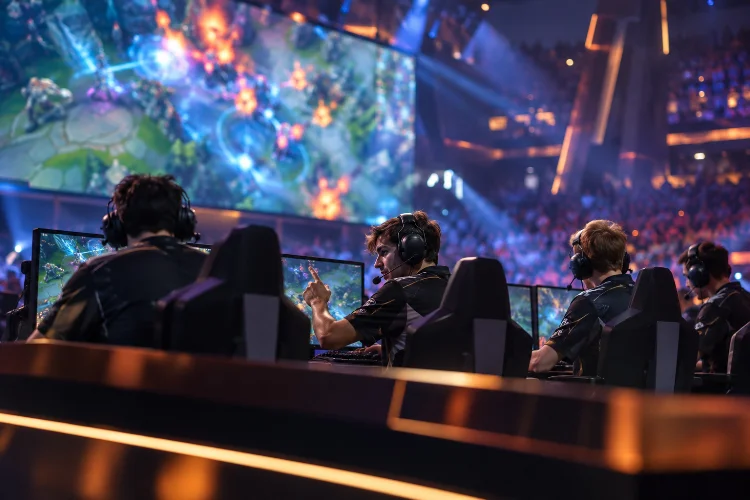
Imagine watching a professional esports match where one team seems completely outmatched. They’re behind in resources, struggling to control the map, and constantly losing individual fights.
Then something unexpected happens.
A perfectly timed rotation catches the opposing team off guard. One coordinated engagement changes the momentum, and suddenly, the team that looked destined to lose is dominating the match.
Was it luck? Not exactly.
Behind almost every incredible esports comeback is a series of intelligent tactical decisions.
Professional gaming isn’t simply about having lightning-fast reflexes, incredible mechanical skills, or the ability to land impossible shots.
While those abilities certainly matter, the real difference between talented players and championship-winning teams often comes down to strategic thinking.
Tactical decision-making in professional esports involves analyzing information, anticipating opponents, managing resources, and choosing the most effective actions under intense pressure.
Whether you’re watching Counter-Strike 2, League of Legends, VALORANT, or Dota 2, tactical choices influence nearly every important moment.
Understanding these decisions reveals why elite esports teams consistently outperform opponents, even when individual skill levels appear remarkably similar.
1. Why Tactical Decision-Making Matters in Professional Esports
At the highest competitive level, mechanical skill alone rarely guarantees victory.
Most professional players already possess exceptional aim, reaction speed, movement control, and game knowledge. What separates successful teams is their ability to turn those individual skills into coordinated strategies.
The Difference Between Mechanical Skill and Tactical Intelligence
Mechanical skill determines how effectively players execute actions. Tactical intelligence determines which actions they should attempt in the first place.
Consider two professional VALORANT players with equally impressive shooting abilities.
One aggressively challenges every opponent, hoping to win through superior aim. The other evaluates enemy positioning, available abilities, teammate locations, and potential escape routes before engaging.
The second player might secure fewer flashy eliminations but contribute more consistently to winning rounds.
That’s because competitive success isn’t always about winning individual confrontations. It’s about choosing situations that provide the greatest strategic advantage.
Understanding Macro and Micro Decisions
Professional esports strategy generally involves two interconnected levels of decision-making.
Macro decisions focus on the bigger picture, including map control, objective priorities, team rotations, resource allocation, and overall match pacing.
Micro decisions involve immediate actions such as positioning during engagements, ability timing, target selection, and choosing when to retreat.
For example, a League of Legends team might make a macro decision to prioritize Dragon rather than attack an enemy turret.
During the resulting teamfight, individual players must make rapid micro decisions about positioning, cooldown usage, and target selection.
Both levels influence the outcome.
A team with excellent mechanical execution but poor macro understanding can still lose because it consistently fights at the wrong moments.
2. Information Gathering Creates a Major Competitive Advantage
One of the most important concepts in professional esports is surprisingly simple: better information leads to better decisions.
However, obtaining reliable information during a fast-paced match is much harder than it sounds.
Players must constantly process enemy movements, available resources, teammate positions, and changing map conditions.
Vision Control and Map Awareness
In games like League of Legends and Dota 2, vision control directly influences strategic opportunities.
Wards and other scouting tools help teams monitor important areas, track enemy movements, and identify potential threats.
Imagine a professional League of Legends team preparing to contest Baron Nashor.
Instead of immediately attacking the objective, the team establishes vision around nearby jungle entrances and removes enemy scouting information.
This preparation provides a clearer understanding of where opponents might approach.
It also creates opportunities to establish favorable positioning before the confrontation begins.
Meanwhile, the opposing team must decide whether entering an area with limited visibility is worth the risk.
That information imbalance can become more valuable than a small gold advantage.
Predicting Enemy Movements
Elite competitors don’t simply react to visible information. They also interpret patterns to estimate what opponents might do next.
In Counter-Strike 2, defenders may notice repeated utility usage around a particular bombsite.
Rather than assuming every smoke grenade indicates an immediate attack, experienced players consider previous rounds, timing patterns, and the enemy’s available resources.
Perhaps the utility is intended to force defensive rotations while the actual attack develops elsewhere.
Recognizing this possibility allows the defending team to avoid an expensive positional mistake.
A useful tactical habit is separating confirmed information from assumptions.
Knowing that two enemies were spotted near a location is different from assuming the entire opposing team is there.
That distinction prevents unnecessary rotations and makes team decisions considerably more reliable.
3. Resource Management Determines Which Battles Are Worth Fighting
Professional esports matches often revolve around limited resources.
These resources may include money, equipment, ammunition, abilities, cooldowns, health, or important map objectives.
Successful teams understand that resources have value beyond the current confrontation.
Economy Management in Tactical Shooters
In VALORANT and Counter-Strike 2, decisions about purchasing equipment can influence several consecutive rounds.
A team might have enough money to purchase weaker weapons immediately, but doing so could leave players without sufficient resources for a stronger purchase in the following round.
Instead, the team may choose an economy round, accepting reduced immediate firepower to improve its future chances.
This doesn’t necessarily mean surrendering the round.
Teams can still design coordinated strategies around inexpensive weapons, close-range engagements, and unexpected positioning.
The important point is that purchasing decisions should support a broader match plan.
Riot Games’ official VALORANT beginner’s guide explains how players use credits to purchase weapons and abilities before rounds, highlighting the connection between spending choices and gameplay preparation.
Managing Resources in MOBA Games
Resource allocation works differently in multiplayer online battle arena games, but the underlying principle remains similar.
League of Legends teams must consider gold, experience, champion abilities, summoner spells, and objective availability.
Suppose a team has several important abilities on cooldown while the enemy team is approaching Dragon.
Attempting to contest immediately might create an unfavorable engagement.
A smarter alternative could involve giving up the objective while securing minion waves, collecting jungle resources, or applying pressure on the opposite side of the map.
The tactical decison is about comparing potential rewards against the resources required.
Strong teams recognize that not every objective deserves a fight.
Sometimes, accepting a temporary disadvantage creates better opportunities later.
4. Map Control, Rotations, and Timing Shape Match Momentum
Map control is one of the clearest indicators of strategic strength in professional esports.
Controlling important territory gives teams more options while limiting what their opponents can safely accomplish.
However, maintaining control requires constant adjustments.
Why Positioning Matters More Than It Appears
Consider a Counter-Strike 2 team defending a bombsite.
Rather than positioning every player directly inside the objective area, defenders may establish control over nearby corridors and important access points.
This positioning can provide earlier information about incoming attacks while making enemy movements more difficult.
However, overly aggressive positioning can also expose defenders to unnecessary eliminations.
The challenge involves balancing territorial control with survivability.
Similar principles apply in League of Legends, where controlling river entrances and jungle pathways can help teams approach neutral objectives safely.
Rotations and Strategic Timing
Rotations involve moving players between locations to respond to threats or create opportunities.
A successful rotation can transform an ordinary situation into a decisive advantage.
Imagine a VALORANT attacking team applying pressure toward one bombsite while quietly repositioning several players toward another.
If defenders commit too many resources to the initial location, the attackers may encounter weaker resistance elsewhere.
However, rotating too slowly can give defenders enough time to recover.
That’s why professional teams consider the timing of every movement.
They evaluate enemy positioning, available abilities, travel distances, and the amount of information their opponents possess.
Effective rotations aren’t simply about moving quickly. They’re about arriving when the strategic advantage is greatest.
The same principle explains why elite MOBA teams frequently prepare minion waves before contesting objectives.
Proper wave positioning forces opponents to choose between responding to lane pressure and joining an important teamfight.
This creates opportunities even before direct combat begins.
5. Team Communication Turns Individual Decisions Into Coordinated Strategy
Even the smartest tactical idea becomes ineffective when teammates don’t understand it.
Professional esports requires players to exchange information while performing complex actions under considerable pressure.
That’s where communication becomes a competitive skill of its own.
The Role of In-Game Leaders
Many tactical shooter teams rely on an in-game leader, commonly called an IGL, to coordinate strategic decisions.
An IGL may organize opening strategies, interpret enemy movements, coordinate utility usage, and make important mid-round adjustments.
However, effective leadership doesn’t mean one player must make every decision.
Teammates frequently provide critical information and suggest adjustments based on their positions.
The leader’s responsibility is often to turn those individual observations into a clear collective plan.
A 2021 study titled Leveling Up Teamwork in Esports found that experienced players used shared knowledge of teammate abilities and personalities to anticipate responses and reduce the amount of verbal communication required.
This shared understanding makes coordinated execution faster and more natural.
Why Clear Callouts Matter
During intense engagements, excessive communication can become distracting.
Professional players generally benefit from short, precise, actionable information.
For example, saying that two opponents are approaching a specific location communicates more useful information than repeatedly shouting that enemies are nearby.
Clarity allows teammates to respond without wasting valuable time interpreting the message.
A 2025 study published in the Journal of Sport & Exercise Psychology analyzed 4,040 statements across eight Counter-Strike: Global Offensive matches.
Researchers found that expert teams communicated more frequently and effectively than nonexpert teams, emphasizing factual and action-related statements.
The study also identified more balanced participation among expert teammates.
These findings reinforce an important principle: effective communcation supports faster collective decisions.
Professional teams must develop trust alongside communication skills.
When teammates understand their responsibilities and trust agreed-upon strategies, they can execute complicated plans without constantly questioning one another.
6. Tactical Adaptation Separates Great Teams From Predictable Ones
Every professional esports team enters competition with a strategic plan.
However, even excellent preparation cannot predict everything an opponent might do.
Successful teams must recognize when their original approach stops working.
Reading Opponent Patterns
Professional teams often study previous matches to identify tendencies.
They examine preferred strategies, defensive setups, drafting priorities, rotation habits, and reactions to specific situations.
Imagine a Counter-Strike 2 team repeatedly encountering aggressive defensive pushes.
Instead of continuing to execute the same opening strategy, the attackers could slow their approach and establish positions designed to punish those pushes.
If the defenders continue their aggressive behavior, the attackers may gain early numerical advantages.
However, the defenders might eventually recognize the adjustment and change their approach.
This creates an ongoing strategic battle in which both sides continuously reassess available information.
Making Decisions Under Pressure
Adaptation becomes especially difficult during elimination matches or decisive rounds.
Players experience pressure from tournament expectations, audience attention, limited time, and the possibility of making costly mistakes.
These conditions can encourage rushed decisions or excessive caution.
Strong teams establish shared principles that help guide their actions when the situation becomes chaotic.
For example, a team might prioritize regrouping after losing an early engagement rather than attempting several disconnected individual plays.
Another team may deliberately increase aggression when it identifies opponents struggling against fast-paced strategies.
Neither approach is automatically correct.
The best response depends on the matchup, available resources, and changing match conditions.
Research published in Computers in Human Behavior in 2026 examined decision-making among five semiprofessional League of Legends players.
The researchers identified 21 heuristic units, or experience-based decision shortcuts, across five core teamfight demands.
This illustrates how practiced players develop mental frameworks to handle complicated situations without analyzing every possibility from scratch.
In professional matches, those frameworks help teams remain adaptable without abandoning strategic discipline.
7. How Professional Esports Teams Train Better Tactical Decisions
Excellent decision-making isn’t simply an instinct that talented players are born with.
Like aim, positioning, and mechanical execution, strategic thinking can improve through structured practice.
Professional organizations increasingly recognize that successful training must develop both individual ability and collective understanding.
Reviewing Matches and Identifying Mistakes
Video-on-demand review, commonly called VOD review, is a valuable method for studying competitive performance.
Players and coaches revisit recorded matches to examine what happened, why particular decisions were made, and which alternatives might have produced better results.
For example, a team might lose an important objective after approaching without sufficient vision.
Rather than blaming the final player eliminated, coaches can investigate earlier choices that created the disadvantage.
Was the team late establishing map control? Were important abilities unavailable? Did players misunderstand the opponent’s positioning?
These questions reveal problems that mechanical practice alone cannot address.
Practicing Specific Tactical Scenarios
Scrimmages allow professional teams to test strategies against other competitive lineups.
However, simply playing additional matches doesn’t always guarantee meaningful improvement.
Structured practice can focus on specific challenges, such as defending disadvantaged situations, coordinating rotations, or executing strategies with limited resources.
A VALORANT team might repeatedly practice retaking a bombsite after the Spike has been planted.
The objective isn’t necessarily to win every attempt.
Instead, players work on utility timing, information sharing, spacing, and coordinated engagements.
Over time, repeated exposure builds familiarity with situations that previously required lengthy discussion.
Measuring Decisions Beyond the Scoreboard
Traditional statistics such as eliminations, assists, damage, and objective control remain useful.
However, they don’t always explain why a team wins.
A player may produce fewer eliminations while consistently creating favorable situations for teammates.
Similarly, a support player might contribute more through positioning and information control than through direct damage.
A 2025 study titled Cultivating Teamwork in Esports examined behavioral data from 80 professional gamers across 16 teams.
Its findings linked measurable coordination patterns with offensive and defensive outcomes, showing why teamwork deserves attention alongside individual performance.
Coaches can combine match statistics with video analysis to understand whether tactical choices are producing sustainable advantages.
The goal is to establish a consistant improvement process that rewards intelligent execution rather than flashy highlights alone.
Tactical decision-making plays a fundamental role in determining how professional esports matches unfold.
From gathering information and controlling territory to managing resources, coordinating teammates, and adapting to opponents, every important choice can influence the final outcome.
Mechanical skill remains essential, but elite competition demands much more than impressive individual performances.
The strongest teams understand when to attack, when to retreat, which objectives to prioritize, and how to turn limited information into effective collective action.
More importantly, they continually improve these abilities through preparation, structured practice, and detailed match analysis.
Whether you’re an aspiring professional player, a competitive gaming enthusiast, or an esports fan, learning to recognize tactical decisions can completely change how you experience a match.
Next time you watch a professional esports tournament, look beyond the highlight plays and pay attention to the decisions that made those moments possible.
You might discover that the smartest play happens long before the final elimination.