
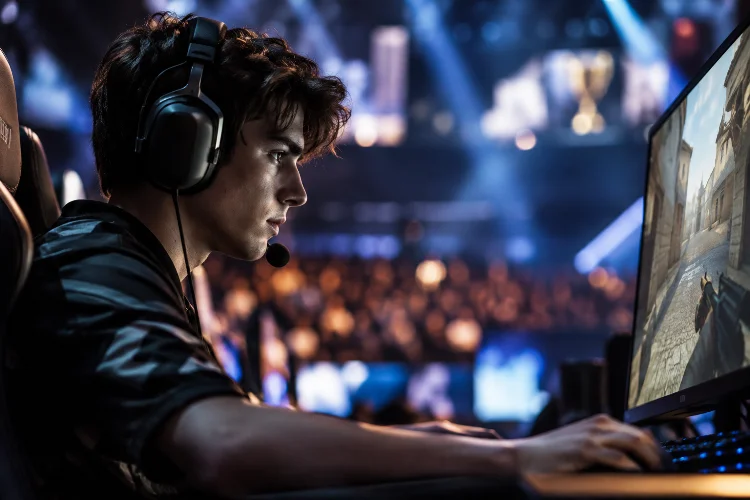
Imagine watching the final round of a major esports tournament. Both teams are evenly matched, the pressure is intense, and one mistake could decide who takes home the championship.
Suddenly, a player makes what seems like a simple movement toward a different position. Seconds later, that decision creates the perfect opportunity for a game-winning play.
Pretty impressive, right?
What makes moments like these fascinating is that they rarely happen by accident.
At the professional level, positioning is one of the most important factors separating talented players from truly exceptional competitors.
Winning isn’t always about having faster reactions, better aim, or more aggressive mechanics. Sometimes, the smartest player simply knows exactly where to stand, when to move, and how to create an advantage before the fight even begins.
That’s why understanding advanced positioning strategies for high-stakes esports matches is essential for serious competitors.
Whether you’re playing Counter-Strike 2, Valorant, League of Legends, Dota 2, or battle royale titles, intelligent positioning can completely transform your competitive performance.
Let’s explore how professional-level positioning works and why mastering it can help you make smarter decisions when every second matters.
1. Understanding the Fundamentals of Advanced Esports Positioning
Positioning might sound like a simple concept.
After all, you’re just deciding where your character should stand, right?
Not exactly.
In professional esports, positioning involves controlling space, anticipating opponent movement, managing visibility, and creating favorable engagements.
The objective isn’t simply finding a safe location. It’s choosing a position that supports your team’s strategy while limiting what opponents can accomplish.
Positioning Is About Creating Advantages
Consider two players with similar mechanical abilities.
One repeatedly challenges opponents in open areas, relying on fast reactions to win engagements. The other carefully uses cover, predicts enemy movement, and only takes fights when the situation offers a reasonable advantage.
Over multiple rounds, the second player will often have better opportunities to contribute consistently.
That’s because effective positioning improves your chances before combat actually begins.
Riot Games’ Valorant Beginner’s Guide highlights the importance of understanding maps, checking angles, and selecting agents whose abilities complement specific environments.
Those fundamentals become even more valuable as competition intensifies.
Balance Safety With Tactical Influence
One common mistake is assuming that the safest position is automatically the best one.
Sometimes, hiding too far from an important objective makes you practically useless to your team.
A strong position should allow you to influence the match while maintaining reasonable opportunities to retreat or receive assistance.
Ask yourself whether your location provides useful information, supports teammates, or controls an important route.
If it accomplishes none of those things, you might need to reposition.
2. Master Angle Control and Defensive Positioning
Angle management is especially important in tactical shooters such as Valorant and Counter-Strike 2.
At high competitive levels, small differences in positioning can determine who sees an opponent first and who survives an engagement.
Understand Common Angles and Off-Angles
A common angle is a location opponents frequently expect someone to defend.
An off-angle is a less conventional position that can surprise an enemy who is pre-aiming standard defensive spots.
For example, an attacker entering a bombsite might carefully check familiar corners while overlooking an unexpected position slightly farther into the room.
A defender holding that unusual angle could gain a valuable moment to react.
However, off-angles aren’t automatically superior.
They can become dangerous when players have no nearby cover or escape route.
The ideal choice depends on enemy information, available utility, weapon selection, and teammate support.
Minimize Exposure During Engagements
Another important technique involves reducing how much of your character opponents can see.
Instead of standing in the middle of an open pathway, position yourself near cover that limits incoming fire.
This principle is particularly important when holding narrow corridors or contested objectives.
Imagine defending a bombsite entrance.
Standing in an exposed location might allow multiple opponents to attack you simultaneously. Holding a controlled angle near cover could make it easier to isolate one opponent before retreating.
You should also consider the geometry of corners.
Depending on the game’s camera and player models, distance from a corner can affect how much of your character becomes visible during a peek.
Practice these situations in custom matches rather than assuming every angle behaves identically.
Avoid Predictable Defensive Habits
Even excellent positions become less effective when opponents expect them.
If you defend the exact same corner every round, experienced players will eventually start preparing specific counters.
Rotate between reliable defensive spots, occasional off-angles, and deeper positions when the situation allows.
Riot’s Valorant Patch 11.08 Notes illustrate how seriously map geometry affects competitive balance.
The update adjusted Pearl’s B-site sightlines and cover to reduce overly powerful defensive positions and encourage more direct engagements.
The lesson is simple: positioning advantages depend on map design, and they can change as the game evolves.
3. Control High-Value Map Areas and Strategic Territory
Map control is one of the defining elements of professional esports strategy.
But controlling territory doesn’t necessarily mean occupying as much space as possible.
Instead, successful teams focus on locations that provide information, restrict enemy movement, or create better access to objectives.
Identify High-Value Positions
Every competitive map contains locations that offer disproportionate strategic value.
These might include central pathways, elevated platforms, objective entrances, narrow corridors, or areas providing information about enemy rotations.
In Counter-Strike 2, central map control can influence how quickly a team moves between different attack routes.
In League of Legends, controlling jungle entrances and nearby vision can make objective preparation considerably safer.
The key is understanding why a location matters.
A position becomes valuable when it creates meaningful tactical options.
For instance, occupying a central pathway may give your team access to multiple destinations, making your next movement harder to predict.
Use Vision to Support Positioning
Information gathering and positioning work together.
You can’t reliably control an area if you have no idea where opponents might approach from.
In MOBA games, vision tools help teams recognize enemy movement and plan engagements around important objectives.
Riot’s League of Legends Patch 26.1 Notes introduced Faelights, which expand vision coverage when wards are placed at designated locations.
This mechanic demonstrates how vision placement influences strategic opportunities.
Rather than placing vision randomly, consider which routes opponents must travel and where your team intends to fight.
A carefully positioned ward can provide the information needed to avoid a dangerous engagement or prepare a coordinated response.
Recognize When Territory Is No Longer Worth Defending
One underrated skill is knowing when to surrender an area.
Some players become so focused on defending a particular position that they ignore changing circumstances.
Suppose several opponents approach a contested location while your teammates are still rotating.
Remaining there without an escape plan could give the enemy an easy elimination.
Retreating temporarily may preserve your team’s resources and create a better opportunity to reclaim the area later.
Smart competitors don’t defend every inch of the map at all costs.
They prioritize positions that contribute to winning.
4. Improve Team Positioning, Crossfires, and Rotation Timing
Individual positioning becomes significantly more powerful when combined with coordinated teamwork.
Professional teams don’t simply occupy strong locations seperately.
They establish interconnected positions that allow teammates to support each other, exchange information, and respond to changing situations.
Create Effective Crossfire Setups
A crossfire happens when teammates hold complementary angles against the same area.
Ideally, opponents entering that space must expose themselves to threats from different directions.
Imagine two defenders protecting a bombsite.
One watches the primary entrance while the other holds a different angle covering enemies who commit deeper into the site.
An attacker attempting to challenge the first defender may expose themselves to the second.
This makes coordinated crossfires particularly effective against predictable pushes.
However, proper spacing matters.
If both defenders stand too close together, a single flash, explosive ability, or coordinated attack might compromise both positions.
Maintain Appropriate Trading Distance
Trading refers to eliminating an opponent shortly after that opponent eliminates your teammate.
Good trading requires careful positioning.
If you’re too far behind your teammate, you might not reach the engagement in time.
If you’re directly beside them, both players could become vulnerable to the same attack.
The ideal distance varies according to movement speed, available cover, weapon effectiveness, and map geometry.
Practice moving together while maintaining seperate firing opportunities.
Communicate Rotations Clearly
Rotations become dangerous when teammates move without coordinating their responsibilities.
A player leaving an important defensive position might accidentally expose an entire section of the map.
Before rotating, communicate which area you’re abandoning and whether another teammate can cover it.
A 2025 study in the Journal of Sport and Exercise Psychology analyzed 4,040 in-game statements from expert and nonexpert Counter-Strike teams.
Researchers found that expert players used more effective, task-related communication and shared speaking responsibilities more evenly.
This supports a valuable competitive principle: positioning decisions become easier to coordinate when communication is precise and actionable.
5. Adapt Positioning to Different Esports Genres
Not every esports title rewards the same positioning techniques.
Tactical shooters emphasize sightlines and controlled engagements, while MOBAs prioritize team formations, ability ranges, and objective control.
Battle royale games introduce additional challenges involving changing safe zones and unpredictable enemy locations.
Understanding these differences helps players apply positioning principles more effectively.
Teamfight Positioning in MOBA Games
In League of Legends and Dota 2, teamfight positioning often depends on your character’s role.
Frontline characters generally attempt to absorb pressure, threaten enemy carries, or prevent opponents from reaching vulnerable teammates.
Damage-focused characters often benefit from positions that allow them to attack while avoiding unnecessary exposure.
Support-oriented characters may need to stay close enough to assist allies without becoming easy targets themselves.
Riot’s League of Legends How to Play Guide explains how different positions and champion roles contribute to overall team composition.
Consider a marksman entering an important late-game teamfight.
Moving too far forward might create a tempting damage opportunity, but it could also expose them to crowd control or an enemy assassin.
Staying near supportive teammates may produce more sustained damage across the entire fight.
Sometimes, surviving an additional few seconds matters more than immediately attacking the nearest vulnerable opponent.
High-Ground Positioning in Battle Royale Games
Battle royale positioning introduces another important concept: elevation.
High ground can provide broader visibility and favorable firing angles, depending on the game’s terrain and combat mechanics.
However, elevated terrain can also expose players to opponents approaching from multiple directions.
Imagine your squad controlling a hill near the next safe zone.
You might gain useful information about approaching enemies, but holding that position becomes dangerous if several teams can attack simultaneously.
Evaluate available cover, nearby escape routes, and potential third-party engagements before committing.
The best elevated position isn’t necessarily the highest one.
It’s the location offering the strongest balance between visibility, protection, and movement options.
Positioning Around Objectives
Across genres, objective-based positioning follows a common principle.
Teams should control the routes and spaces that matter most before committing to an objective.
In a MOBA, that could mean preparing vision and managing nearby lanes before starting Baron Nashor.
In a tactical shooter, it might involve securing surrounding angles before planting the objective.
In battle royale games, reaching advantageous terrain before a zone closes can reduce the need for risky movement later.
Good preparation makes important engagements less chaotic.
6. Make Better Positioning Decisions Under Competitive Pressure
High-stakes matches introduce emotional pressure that can influence player movement.
When a championship round approaches, players sometimes abandon disciplined positioning in favor of unnecessary aggression.
Others become overly cautious and miss opportunities that could secure victory.
Professional-level decision-making requires balancing both extremes.
Adjust Positioning Based on Player Advantage
One of the most important considerations is the current number of surviving players.
Imagine your team has a five-versus-three advantage in Valorant.
Taking isolated fights may give your opponents unnecessary opportunities to recover.
Instead, maintaining coordinated positions and supporting teammates can make that advantage more difficult to overcome.
Now imagine you’re defending a two-versus-four disadvantage.
You may need to create an unexpected engagement, isolate an opponent, or reposition to reduce the enemy team’s numerical advantage.
These situations require different approaches.
The correct position depends on the current state of the match, not a fixed rule.
Use Timing to Create Unexpected Openings
Positioning becomes even more effective when combined with good timing.
A strong flank can fail if the player arrives too early and reveals their location.
The same movement could be highly effective if coordinated with teammates beginning an engagement elsewhere.
Consider an attacker moving through a secondary route while the rest of the team applies pressure to an objective.
If the attacker reaches the enemy’s rear position at the right moment, defenders may have to divide their attention.
However, attempting the same flank without information might result in an isolated elimination.
Timing and positioning should always support the same tactical goal.
Maintain Discipline During Clutch Situations
Clutch situations reward patience, creativity, and information management.
When you’re the final surviving player, every movement potentially reveals your intentions.
Avoid repositioning without understanding what you’re trying to accomplish.
Sometimes remaining hidden creates an opportunity to catch an opponent rotating.
Other times, moving immediately prevents the opposing team from surrounding your location.
There’s no universal solution.
The important thing is making deliberate decisions instead of reacting emotionally.
Remain consistant with your decision-making process, even when the pressure becomes intense.
7. Train Advanced Positioning Through Replay Analysis and Practice
Understanding positioning concepts is only the beginning.
Applying them consistently requires deliberate training, regular evaluation, and the willingness to recognize mistakes.
Fortunately, modern competitive games provide numerous opportunities to study positional decision-making.
Analyze Your Gameplay From Different Perspectives
Replay analysis allows players to identify positioning problems that might be difficult to notice during live matches.
For example, you might believe you lost a duel because your opponent reacted faster.
After reviewing the replay, you could discover that your position exposed you to several angles simultaneously.
That’s a different problem requiring a different solution.
Riot’s Valorant Replay System Guide describes features including multiple player perspectives, free-camera observation, playback speed controls, and timeline navigation.
These tools are particularly useful for examining how positioning develops throughout a round.
Study Professional Matches With Specific Questions
Watching professional esports can provide valuable insights, but passive viewing has limitations.
Instead of focusing exclusively on highlight plays, observe how competitors move before engagements begin.
Pay attention to where defenders establish their initial positions and how those positions change as information becomes available.
Notice when players abandon areas, how teammates maintain spacing, and which routes are used during rotations.
Try watching the same sequence more than once.
The first viewing can help you understand what happened, while the second can reveal why certain positional decisions were effective.
Create Positioning-Focused Training Sessions
A structured practice routine can accelerate improvement.
For example, dedicate one session to defensive angle discipline, another to coordinated rotations, and another to objective positioning.
During team practice, recreate common scenarios and experiment with different setups.
Try defending the same location using several formations.
Then evaluate which approach provides the best information, escape routes, and teammate support.
Record the results so your team can identify repeatable improvements.
Measure Positioning Quality, Not Just Eliminations
Traditional statistics don’t always reveal the quality of a player’s positioning.
A player might finish a match with fewer eliminations while successfully controlling important territory or protecting vulnerable teammates.
Consider reviewing practical indicators such as unnecessary deaths, successful trades, survival during objective fights, and situations where poor spacing creates preventable losses.
You can also track how often you survive after gathering information or whether your team maintains defensive coverage during rotations.
These measurements won’t tell the entire story.
However, they can reveal recurring weaknesses that ordinary kill-death statistics overlook.
And that’s what makes positioning analysis so valuable.
It helps you understand not just whether a play succeeded, but whether the decision behind it was actually reasonable.
Mastering advanced positioning strategies for high-stakes esports matches involves much more than finding good hiding spots or memorizing popular angles.
It’s about understanding map control, managing exposure, maintaining effective team spacing, and adapting your movement to the evolving state of the match.
Strong competitors recognize that positioning affects nearly every major tactical decision, from defensive setups to objective fights and last-second clutch situations.
The good news is that these skills can improve through focused practice and thoughtful gameplay analysis.
Start by reviewing your recent matches and identifying moments where better positioning could have changed the outcome.
Experiment with alternative angles, communicate more effectively with teammates, and develop stronger map awareness.
Ready to elevate your competitive gameplay? Apply these positioning techniques in your next match and start creating tactical advantages before the fight even begins.