
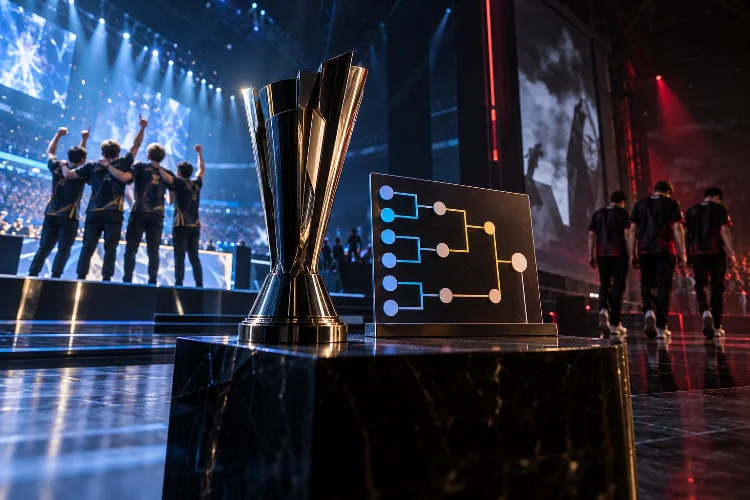
Imagine your favorite esports team dominating an entire season, defeating nearly every major opponent, and entering a championship as the clear favorite.
Then, one bad match happens.
Suddenly, they’re eliminated, and a lower-ranked team moves closer to lifting the trophy.
Sounds unfair? Maybe. But that’s exactly how some competitive tournaments are designed to work.
In professional esports, winning isn’t determined entirely by mechanical skill, tactical knowledge, or teamwork. The structure of the competition itself can significantly influence which teams survive, which strategies become effective, and who eventually becomes champion.
That’s why understanding competitive tournament formats is essential for anyone interested in professional gaming.
From single-elimination brackets to Swiss stages and round-robin leagues, every format creates different challenges and opportunities.
Some reward consistency over several matches, while others emphasize performing under extreme pressure when there’s no second chance.
Interestingly, tournament structure can even change how teams approach drafting, opponent preparation, and risk-taking.
In this article, we’ll explore how different tournament systems influence esports outcomes, why organizers choose particular formats, and what these decisions mean for players, teams, and fans.
1. Why Tournament Structure Matters in Professional Esports
At first glance, tournament organization might seem like a simple administrative decision.
Teams register, organizers create a schedule, matches take place, and the strongest competitor eventually wins.
But competitive gaming is rarely that straightforward.
Tournament Rules Shape Competitive Opportunities
Every tournament format determines how many chances teams receive, which opponents they face, and how much individual results matter.
For example, a single-elimination competition removes teams immediately after one series loss. A double-elimination tournament usually allows participants to recover from an earlier defeat.
Meanwhile, round-robin formats measure performance across several opponents rather than relying on one decisive matchup.
These differences can produce completely different championship paths.
A team that struggles during its opening match might disappear immediately in one format but eventually reach the grand final in another.
Understanding Competitive Integrity
Tournament organizers often aim to balance competitive integrity, entertainment value, and scheduling efficiency.
Competitive integrity involves creating conditions where results meaningfully reflect skill and performance.
However, identifying the strongest team isn’t always the same as creating the most entertaining event.
A tournament filled with predictable results might provide a useful measurement of team strength but lack dramatic surprises.
On the other hand, a highly unpredictable competition can generate excitement while increasing the possibility of unexpected eliminations.
Research published in the European Journal of Operational Research identifies efficacy, fairness, and attractiveness as major considerations in tournament design.
That framework helps explain why esports organizers don’t universally adopt a single competitive structure.
2. Single-Elimination Tournaments: High Stakes and Unexpected Upsets
Single elimination is among the simplest tournament formats.
Lose one series, and your championship journey ends.
There’s no lower bracket, no recovery match, and no opportunity to correct an earlier mistake.
Why Single Elimination Creates Intense Competition
Imagine an eight-team playoff bracket.
The quarterfinal winners advance to the semifinals, followed by the final two teams competing for the championship.
Only seven series are required to determine the winner.
This structure makes the event relatively efficient while giving every matchup immediate consequences.
From a spectator’s perspective, that’s incredibly exciting.
One successful strategy, clutch performance, or unexpected comeback can change the entire tournament.
How Upsets Become More Important
The biggest limitation is that a single series doesn’t always represent a team’s overall strength.
Even elite competitors have bad days.
A team might struggle with an unfamiliar opponent, misread the current game meta, or simply fail to perform under pressure.
In a single-elimination bracket, those temporary problems can end its entire campaign.
This creates opportunities for underdogs who prepare effectively for specific opponents.
Riot Games has discussed how single elimination rewards immediate preparation, adaptation, and high-pressure performance while preserving the possibility of surprising results.
However, it also means that the eventual winner isn’t necessarily the team that would perform best across repeated competitions.
When Single Elimination Works Best
This format is particularly suitable when organizers want dramatic playoffs and a manageable event schedule.
It also works well as the final stage of a larger championship where teams have already passed through extensive qualification rounds.
The League of Legends World Championship used this approach in 2025, placing eight teams into a single-elimination knockout bracket after the Swiss Stage.
By that point, participants had already demonstrated enough competitive strength to reach the final phase.
3. Double-Elimination Brackets: Giving Strong Teams Another Chance
Double elimination addresses one of the biggest concerns surrounding traditional knockout tournaments.
Instead of eliminating competitors after one defeat, teams generally need to lose twice before leaving the competition.
This creates an upper bracket and a lower bracket.
How the Lower Bracket Changes Everything
Imagine Team A losing its opening playoff match.
In single elimination, that would end its tournament.
Under double elimination, Team A moves into the lower bracket, where it can continue competing.
If the team wins several consecutive series, it may eventually reach the grand final.
These lower-bracket runs often produce some of the most memorable storylines in esports.
They also reward adaptability because teams must recognize mistakes quickly and improve against increasingly difficult opponents.
Why Double Elimination Can Favor Consistency
The additional opportunity reduces the impact of one unexpected loss.
A strong team that struggles during a single series still has a chance to demonstrate its abilities.
This can make championship results less sensitive to temporary performance fluctuations.
For example, the 2025 VALORANT Champions Tour incorporated double-elimination brackets into several competitive stages, including international league playoffs.
Riot’s tournament design aimed to provide additional competitive opportunities while maintaining meaningful matches.
However, double elimination doesn’t automatically guarantee that the strongest team wins.
Opponent matchups, player conditions, and the exact bracket rules still matter.
The Grand Final Fairness Debate
One particularly interesting issue involves the upper-bracket finalist.
That team may reach the final without losing a single series, while its opponent arrives after surviving the lower bracket.
Some tournaments use a bracket reset, requiring the lower-bracket finalist to win two final series.
Others use a single grand-final series without a reset.
In the second arrangement, the undefeated team can lose the championship after its first defeat.
Riot has openly discussed this trade-off when comparing tournament structures.
Double elimination creates more recovery opportunities, but organizers must decide how to reward teams that reach the final without losing.
4. Round-Robin Formats: Rewarding Consistent Team Performance
Round robin takes a different approach to competition.
Instead of focusing primarily on elimination, teams compete against every other participant in their assigned group or league.
This creates a broader performance record.
How Round Robin Measures Team Strength
Imagine a six-team group where every participant faces the other five teams once.
The group would contain fifteen matches in total, giving each team five opportunities to earn results.
A single defeat doesn’t necessarily destroy a team’s chances.
Instead, overall performance determines the standings.
This benefits teams capable of maintaining relatively consistent results across different opponents.
It also reduces the influence of an unlucky opening matchup.
Why Matchup Diversity Matters
Different esports teams have different strengths.
Some prefer aggressive early-game strategies, while others excel during slower tactical engagements.
A round-robin competition exposes participants to multiple playing styles.
This can provide a more informative evaluation than a tournament where teams face only a small number of opponents.
For example, the 2025 VALORANT international leagues used six-team round-robin groups during their regular-season stages.
Teams then qualified for playoffs based on group performance, creating a connection between sustained results and championship opportunities.
The Problem With Low-Stakes Matches
Round robin isn’t perfect.
When a team has already secured qualification or been mathematically eliminated, its remaining matches may have limited consequences for its own position.
This can influence motivation, experimentation, and competitive intensity.
Tiebreaker rules may also become important when several teams finish with identical records.
Organizers must establish clear procedures involving head-to-head results, map differential, or other measurements.
Without transparent regulations, seemingly minor results can create confusing qualification disputes.
5. Swiss Tournament Formats: Balancing Fairness and Efficiency
The Swiss system has become an important feature of major esports competitions.
Unlike traditional round robin, teams don’t need to face every opponent.
Instead, they progress through multiple rounds, typically facing opponents with similar win-loss records.
How Swiss Pairings Work
Consider a sixteen-team tournament.
After the opening round, eight teams have a 1-0 record while eight have a 0-1 record.
In a common Swiss implementation, teams with matching records face each other during subsequent rounds.
This creates increasingly meaningful matchups as the tournament progresses.
Successful teams face other successful teams, while participants with early losses compete against opponents in similar positions.
Specific pairings still depend on seeding, draw procedures, and restrictions on repeated matchups.
Why Swiss Reduces Early Elimination Pressure
The system offers an alternative to immediately removing a team after one disappointing performance.
At the 2025 League of Legends World Championship, teams advanced from the Swiss Stage after achieving three match wins and were eliminated after three losses.
Eight of the sixteen participants progressed to the knockout stage.
This created different potential qualification paths, including records of 3-0, 3-1, and 3-2.
A team could lose early and still recover through later matches.
Similarly, the 2025 BLAST.tv Austin Major used Swiss stages to determine progression in Counter-Strike 2.
Its structure combined shorter opening matches with longer series for advancement and elimination situations.
Is Swiss Actually More Fair?
Research into tournament design suggests that Swiss systems can be effective at identifying relative participant strength.
A study titled The Efficacy of Tournament Designs found Swiss particularly accurate in ranking competitors across the simulation assumptions examined.
However, that doesn’t mean Swiss always produces the fairest possible outcome.
Teams may face different levels of opposition despite finishing with identical records.
Tie-breaking systems and initial seeding can also influence their paths.
Consequently, Swiss combines scheduling efficiency with useful competitive comparisons, but its results still require context.
6. Best-of-One vs. Best-of-Five: How Series Length Changes Results
Tournament brackets aren’t the only factor influencing esports outcomes.
The number of games played in each series can also change which teams are most likely to win.
This is where best-of-one, best-of-three, and best-of-five formats become important.
Why Best-of-One Encourages Surprises
In a best-of-one series, everything depends on a single game or map.
One unexpected strategy can provide a decisive advantage.
For example, a Counter-Strike 2 team might prepare an unusual tactical approach that opponents haven’t previously encountered.
If that strategy works, there may be no second map to respond.
This makes best-of-one matches exciting and somewhat unpredicatable.
However, they also provide fewer opportunities for teams to demonstrate adaptability.
Longer Series Reward Adaptation
In a best-of-three, the first team to win two games takes the series.
A best-of-five requires three victories.
Longer series give teams opportunities to adjust strategies, respond to opponent tendencies, and explore different maps or compositions.
Consider a hypothetical matchup where Team A has a 65% probability of winning each individual game.
Assuming each game is independent and that probability remains constant, the results look like this:
| Series Format | Team A’s Win Probability |
|---|---|
| Best-of-One | 65.0% |
| Best-of-Three | 71.8% |
| Best-of-Five | 76.5% |
These values are illustrative mathematical calculations, not real esports performance statistics.
They demonstrate how repeated games can increase the series-winning probability of a consistently stronger team.
In reality, game outcomes aren’t fully independent, and win probabilities can change because of drafting, fatigue, map selection, and strategic adjustments.
Drafting Rules Make Series Length Even More Important
Longer series also introduce additional strategic complexity.
In League of Legends, Riot expanded Fearless Draft across major competitions during 2025.
Under this system, champions selected during earlier games of a series become unavailable to both teams in subsequent games.
That means players must demonstrate flexibility rather than repeatedly depending on the same successful composition.
A team with a deeper champion pool can gain advantages as a series progresses.
This highlights an important point: changing the match format can also change which player skills become most valuable.
7. Seeding, Scheduling, and Hybrid Formats Influence Championship Paths
Even when two tournaments use the same basic elimination system, their results may differ because of additional organizational rules.
Seeding, bracket placement, rest periods, and qualification procedures all influence the competitive environment.
These details are easy to overlook, but they can significantly affect a team’s path to victory.
Why Tournament Seeding Matters
Seeding determines how participants are positioned within the competition.
Higher-ranked teams may receive more favorable opening matchups, direct qualification to later rounds, or specific bracket advantages.
For example, the opening Swiss draw at Worlds 2025 separated teams into tiers based on regional qualification positions.
Certain teams could only face opponents from particular tiers in the first round.
The tournament also prohibited same-region matchups during that opening stage.
These rules influenced which opponents teams could encounter before a single game had been played.
The Problem With Difficult Bracket Draws
Imagine two championship contenders being placed on the same side of a single-elimination bracket.
Only one can reach the final, even if both are stronger than several teams on the opposite side.
This creates what fans often describe as an unbalanced bracket.
Similarly, a difficult group can eliminate strong competitors before the playoffs.
Seeding attempts to reduce these situations, but rankings are imperfect.
A team might improve dramatically after qualification, making its assigned seed less representative of its current strength.
Tournament organizers must balance historical achievements against recent performance.
Scheduling, Fatigue, and Preparation
The timing of matches also affects competitive conditions.
A team playing multiple demanding series in a short period may have less time to recover and prepare.
Meanwhile, another participant might receive additional rest because of its position in the bracket.
This creates a potential trade-off.
Extra rest allows more preparation, but teams coming through the lower bracket may benefit from recent competitive experience and momentum.
Neither advantage guarantees victory.
Event organizers must also consider broadcasting schedules, venue availability, travel requirements, and player welfare.
Why Hybrid Tournament Structures Are Popular
Many major esports events combine multiple competitive systems rather than relying on only one.
A tournament might begin with round-robin groups, continue into a Swiss stage, and finish with elimination playoffs.
More commonly, organizers select two complementary structures.
Worlds 2025 combined Swiss qualification with single-elimination knockouts, while VALORANT Champions 2025 used group play followed by double-elimination playoffs.
These combinations attempt to provide reasonable qualification opportunities before introducing more dramatic championship matchups.
The underlying goal is to reward skill while keeping tournaments exciting and practical to operate.
What Players and Fans Should Look For
Understanding a tournament’s rules helps explain why certain teams succeed or struggle.
Before judging a result, consider the number of series played, the difficulty of opponents, the elimination structure, and the advantages created by seeding.
A lower-ranked team reaching the final isn’t automatically evidence of a flawed format.
Likewise, an established favorite losing early doesn’t necessarily mean the competition was unfair.
For teams, the practical lesson is to prepare for the tournament structure rather than treating every match the same.
A short knockout event may reward specialized preparation, while a longer competition requires consistant performance, broad strategic knowledge, and effective recovery.
The strongest tournament preparation accounts for both the game itself and the competitive environment surrounding it.
Competitive tournament formats play a major role in shaping esports outcomes, influencing everything from elimination risk to strategic preparation and championship opportunities.
Single-elimination brackets create intense pressure and memorable upsets, while double elimination allows teams to recover from setbacks.
Round-robin leagues reward sustained performance, and Swiss systems offer a practical balance between competitive comparison and scheduling efficiency.
Meanwhile, match length, seeding, and tournament scheduling introduce additional factors that can shape the final standings.
No single structure is perfect for every esports competition.
The most appropriate format depends on the organizers’ priorities, available resources, and desired balance between fairness and entertainment.
Want to understand professional esports at a deeper level? Start examining tournament brackets, qualification rules, and series formats before your next major event.
You’ll discover that championship victories involve more than great gameplay. The tournament structure helps determine the journey.