
You can win almost every gunfight, dominate your lane, and still lose the match. Sounds frustrating, right?
That’s because competitive gaming isn’t just about mechanical skill. Sometimes, the team with better positioning, smarter movement, and stronger map awareness wins against opponents who are technically more talented.
Imagine playing Counter-Strike 2 and watching your entire squad rotate toward one bombsite, only to discover that the enemy team was attacking somewhere else.
Or picture a League of Legends match where your team wins a fight but loses Dragon because nobody controls the surrounding area.
These situations happen more often than players realize.
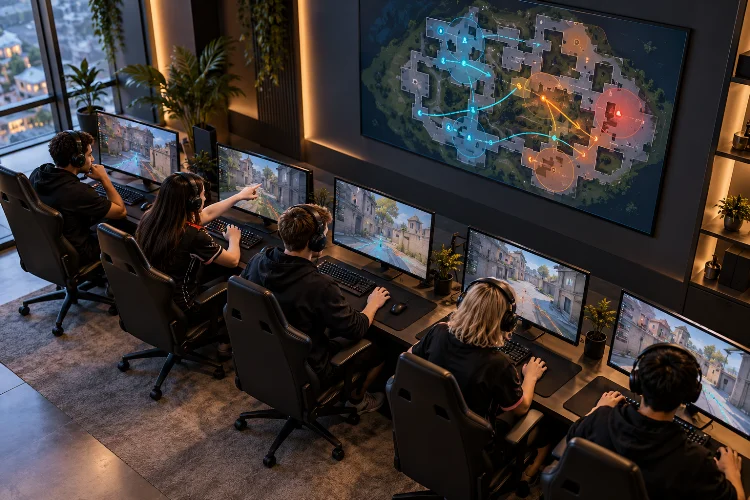
That’s where team rotations and map control become essential. Understanding when to move, which areas to secure, and how to coordinate teammates can completely change the outcome of a match.
Professional esports teams spend countless practice sessions developing these skills because positioning and timing often determine whether a strategy succeeds.
In this guide, we’ll explore how effective rotations work, why controlling territory matters, and how your team can make smarter decisions in high-pressure competitive situations.
1. Understanding Team Rotations and Their Strategic Importance
Team rotations are coordinated movements between different areas of a map to create an advantage, defend important locations, or respond to enemy activity.
At first glance, rotating might seem as simple as moving from one position to another. However, competitive rotations involve careful timing, information gathering, and understanding what the opposing team might do next.
Why Smart Rotations Change Matches
Consider a typical tactical shooter scenario.
Your team has three players defending one bombsite and two protecting another. Suddenly, multiple enemies appear near the first location.
The natural reaction might be to send everyone toward the action.
But what happens if the attackers are deliberately creating a distraction?
Your team could abandon the second bombsite, giving opponents an easy opening.
This is why effective rotations depend on verified information rather than assumptions. Players must evaluate enemy positions, available utility, remaining time, and potential escape routes before committing.
Rotations Across Different Esports Genres
Although tactical shooters provide obvious examples, rotation strategies exist across nearly every team-based competitive game.
In League of Legends, players rotate between lanes, jungle areas, and neutral objectives to establish advantages. In Dota 2, coordinated movement allows teams to pressure towers, secure resources, and create favorable engagements.
Meanwhile, games such as VALORANT and Counter-Strike 2 emphasize bombsite control, defensive repositioning, and coordinated attacks.
The underlying principle remains consistent: move with a purpose rather than simply following the action.
Teams that understand this distinction often make opponents react to their decisions instead of constantly reacting themselves.
2. Reading the Map Before Making a Rotation
One of the biggest differences between average players and experienced competitors is how they interpret information.
Professional teams rarely make major positional changes without considering what they know about the battlefield.
Instead, they continuously analyze enemy movement, contested territory, and potential threats.
Developing Better Map Awareness
Map awareness begins with understanding the environment.
Every competitive map contains important pathways, chokepoints, defensive positions, and high-value areas. Some locations provide powerful sightlines, while others enable faster movement between objectives.
Knowing these features helps players predict how opponents might approach an engagement.
For example, controlling middle areas in Counter-Strike 2 can provide access to multiple attack routes. Losing that control may force defenders to cover additional angles and make their positioning less predictable.
Riot Games describes a tactical decision-making cycle in VALORANT built around gathering intelligence, planning, and execution. The idea is simple: better information creates opportunities for better decisions.
Turning Information Into Action
Gathering information is only useful when players know how to interpret it.
Suppose your team spots three opponents approaching one side of the map. That doesn’t automatically mean the remaining enemies are nearby.
They might be holding another position, preparing a flank, or waiting for your defenders to rotate.
Experienced teams distinguish confirmed sightings from educated guesses.
They also track when information becomes outdated. An enemy spotted several seconds ago may already be somewhere completely different.
Rather than treating every observation seperately, strong teams combine multiple clues to build a more accurate picture of enemy intentions.
The practical lesson is straightforward: before moving, ask what your team actually knows and what it is merely assuming.
3. Optimizing Rotation Timing and Player Responsibilities
Even when a team correctly predicts an opponent’s strategy, poor timing can ruin the response.
Arriving too late might mean losing an objective. Rotating too early can expose another area of the map.
Finding the right moment requires coordination and a clear understanding of individual responsibilities.
Timing Rotations Around Match Conditions
In tactical shooters, rotation timing often depends on round progression.
Early in a round, teams generally prioritize securing space and collecting information. During the middle stages, they evaluate possible attacks and reposition based on emerging patterns.
As time runs low, players must make increasingly decisive commitments.
A defender who leaves a bombsite too early may create an opening for an enemy fake. Someone who waits too long might become irrelevant to the final engagement.
Map design also affects these decisions.
For example, Riot Games’ October 2026 VALORANT Patch 13.08 shortened defender routes on Corrode because long rotation times were making retakes especially difficult.
That change highlights an important strategic reality: movement speed and map geometry directly influence defensive options.
Assigning Clear Rotation Responsibilities
Coordinated teams need more than five players moving toward the same location.
They need defined responsibilities.
An entry player might lead an attack, while a support player provides utility and protects vulnerable routes. A designated anchor may remain at a defensive site until stronger evidence justifies leaving.
The in-game leader usually helps coordinate these decisions, but teammates must also recognize developing situations independently.
For example, if two defenders move toward a threatened bombsite, another player might hold a central position to protect against an unexpected rotation.
This arrangement maintains flexibility without sacrificing defensive coverage.
The key is ensuring everyone understands not only where they should move, but also why that movement matters.
4. Building Strong Map Control Without Overextending
Controlling the map doesn’t mean occupying every possible location.
It means establishing influence over areas that create meaningful tactical advantages.
Those advantages might include better information, safer movement, access to objectives, or opportunities to isolate opponents.
Identifying High-Value Areas
Not every part of a competitive map deserves equal attention.
In Counter-Strike 2, controlling a central chokepoint can restrict enemy movement and create several potential attack options.
In MOBAs, controlling river entrances and jungle intersections can make neutral objectives easier to contest.
These positions become valuable because they influence what happens elsewhere.
Imagine your team holds a central route connecting two important locations. Opponents may need to take longer paths, spend utility clearing your position, or risk moving through territory you control.
You’re not necessarily winning a fight, but you’re making the opposing team’s decisions harder.
Balancing Aggression With Safety
One common mistake is confusing map control with constant aggression.
Pushing deeper into enemy territory might seem productive, but an isolated player can become an easy target.
Good teams expand their territory gradually while maintaining reliable escape routes and nearby support.
In League of Legends, vision control plays a major role in making those movements safer.
The game’s 2026 season introduced Faelights, special locations where wards can reveal additional areas temporarily. Riot designed them to encourage strategic decisions about vision placement rather than simply rewarding players for placing more wards.
This reinforces an important concept: controlling information is often just as valuable as controlling physical space.
Whenever your team captures a new location, consider whether it can actually defend that position.
If maintaining control requires unnecessary risk, retreating to a stronger area may be the smarter choice.
5. Turning Map Control Into Objective Advantages
Territory becomes truly valuable when it helps your team accomplish something.
Holding an important area without converting that advantage into progress may simply waste time and resources.
Successful competitive teams use positioning to create favorable conditions for taking objectives.
Preparing Before an Objective Appears
Let’s use League of Legends as an example.
Suppose Dragon will become available in approximately one minute.
A poorly coordinated team might continue farming until the objective appears, then rush toward the river without checking enemy positions.
A better-organized team starts preparing earlier.
Players push nearby minion waves, replenish health and resources, establish useful vision, and position themselves around entrances to the objective area.
This preparation forces the opposing team to respond under less favorable conditions.
Strategic guides on objective tracking recommend beginning these preparations ahead of the spawn instead of waiting until the last moment.
The advantage comes from being ready to fight before opponents have fully organized.
Creating Pressure in Tactical Shooters
The same principle applies to bombsite attacks.
Imagine a VALORANT team applying pressure near one location while maintaining control of central pathways.
Defenders might move additional players toward the threatened site.
Once the attackers identify that defensive movement, they can potentially rotate toward a less protected area.
The original pressure doesn’t need to produce eliminations to be effective.
Its purpose is to influence enemy positioning.
However, attacking teams must protect their own movement routes. A successful fake means little if the entire squad gets caught during the transition.
Converting Small Advantages Into Meaningful Progress
A single elimination, successful flank, or cleared defensive position can create a valuable oppurtunity.
But teams must act before that advantage disappears.
For instance, eliminating an opponent near a neutral objective may briefly provide a numbers advantage.
Instead of chasing additional kills, the team might secure vision and begin the objective while the enemy remains disadvantaged.
This is a fundamental concept in competitive strategy: individual victories should contribute to larger goals.
The best teams don’t simply win fights. They understand what those fights allow them to accomplish next.
6. Adapting to Enemy Rotations and Unexpected Strategies
Competitive opponents rarely follow the same strategy throughout an entire match.
Once they recognize your tendencies, they’ll begin exploiting them.
That’s why maintaining flexibility is essential for long-term success.
Recognizing Fake Attacks
Fake attacks are particularly effective against teams that rotate too aggressively.
Imagine hearing several opponents use utility near a bombsite. Your teammates immediately begin moving toward that location.
However, the attackers never fully commit.
Instead, they withdraw and attack the opposite side, where fewer defenders remain.
This situation illustrates the danger of reacting to incomplete information.
One solution is maintaining defensive anchors who delay their rotations until an attack becomes more convincing.
Another is gathering information from areas the enemy has temporarily abandoned.
If defenders can confirm that opponents are leaving one location, they may identify the actual threat before it’s too late.
Counter-Rotations and Adaptive Positioning
Sometimes the strongest response to enemy movement isn’t matching it directly.
Instead, teams can exploit the space their opponents leave behind.
Consider a MOBA team that sees several enemies rotating toward a side lane.
Rather than forcing an unfavorable fight, the remaining players might pressure a different tower or establish control around another objective.
This approach creates trade-offs.
Your opponents gain something in one area, but they surrender opportunities somewhere else.
Successful counter-rotations depend on understanding those exchanges and choosing outcomes that benefit your overall strategy.
Predictability is another major concern.
If your squad uses identical timings and pathways every round, experienced opponents will eventually recognize the pattern.
Varying your approach makes it harder for enemies to anticipate your decisions and prepare effective counters.
7. Improving Team Communication and Strategic Coordination
Even an excellent tactical plan can collapse when teammates misunderstand each other.
One player rotates early, another holds position, and the third assumes everyone is following the original strategy.
Suddenly, the team is fighting in multiple locations without proper support.
Effective communcation prevents these problems.
Making Callouts Clear and Useful
Good callouts should communicate relevant information without overwhelming teammates.
Instead of saying, “They’re all coming here!” after spotting one opponent, a player could say, “Two spotted near B entrance, additional enemies unconfirmed.”
The second message communicates both the observation and its limitations.
Teams should also share intended actions.
A defender saying, “Rotating toward B through spawn,” gives teammates a clearer understanding of how their formation will change.
Short, consistent callouts reduce confusion during fast engagements.
Creating a Shared Decision-Making System
Professional coordination doesn’t mean one person must make every decision.
Although an in-game leader provides direction, teammates often possess information the leader cannot see directly.
Effective squads combine centralized calls with individual initiative.
Players should understand the team’s general priorities well enough to recognize when movement is necessary.
For example, when one teammate secures an important area, nearby players might adjust their positioning automatically to support the advantage.
This shared understanding becomes especially useful during chaotic fights when detailed instructions are difficult.
Teams can develop it through practice, reviewing mistakes, and agreeing on common tactical principles.
Ultimately, reliable coordination is less about talking constantly and more about sharing the right information at the right moment.
8. Training Better Rotations and Measuring Improvement
Understanding rotation strategy is helpful, but applying it consistently requires deliberate practice.
Simply playing more matches doesn’t guarantee that your decision-making will improve.
Teams need structured exercises that focus on specific tactical behaviors.
Practicing With Realistic Scenarios
Start by recreating situations where your squad frequently struggles.
For example, practice defending one bombsite while receiving incomplete information about an attack elsewhere.
Ask players to decide who should rotate, who should remain, and which paths provide the safest movement.
Then repeat the exercise with different enemy positions and timings.
For MOBAs, teams can practice establishing control around an objective before it appears.
The goal isn’t necessarily winning every simulated fight.
It’s developing faster recognition, better positioning, and more consistent decision-making.
Using Match Reviews Effectively
Reviewing recorded matches can reveal mistakes that players overlook during live gameplay.
Instead of focusing exclusively on missed shots or unsuccessful engagements, examine the movements that happened beforehand.
Ask whether teammates rotated too early, entered unprotected areas, or failed to recognize an approaching threat.
Pay particular attention to moments when multiple players died while moving between objectives.
These situations may indicate problems with information gathering or coordination rather than mechanical skill.
Tracking Useful Performance Indicators
Teams can measure tactical progress through several practical indicators:
- Rotation response time: How quickly players react after receiving reliable information.
- Objective conversion rate: How often territorial advantages lead to secured objectives.
- Deaths during rotations: How frequently players get eliminated while changing positions.
- Defensive coverage: Whether important areas remain protected during coordinated movement.
- Information accuracy: How often callouts correctly describe enemy positions and intentions.
These measurements provide context beyond ordinary kill/death statistics.
However, numbers shouldn’t be interpreted without reviewing the match itself.
A slow rotation might be completely justified if the enemy’s attack hasn’t been confirmed.
Similarly, a fast rotation isn’t definately a good decision when it exposes another important location.
The real objective is improving decision quality, not simply moving faster.
With regular reviews, teams can identify recurring weaknesses and gradually develop more reliable strategic habits.
Mastering team rotations and map control can transform how your squad approaches competitive gaming.
Instead of relying entirely on individual mechanics, you’ll begin creating advantages through positioning, information, timing, and coordinated movement.
The most effective teams understand when to push forward, when to rotate, and when holding their current position creates more value than chasing an engagement.
These principles apply across tactical shooters, MOBAs, and many other team-based esports titles.
Improvement doesn’t happen overnight, but even small changes in communication and map awareness can produce noticeable results.
Ready to take your competitive performance to the next level? Start reviewing your team’s rotations, practice objective-focused strategies, and build better coordination during your next matches.
Sometimes, the smartest move isn’t winning another fight. It’s being in the right place before the fight even begins.