
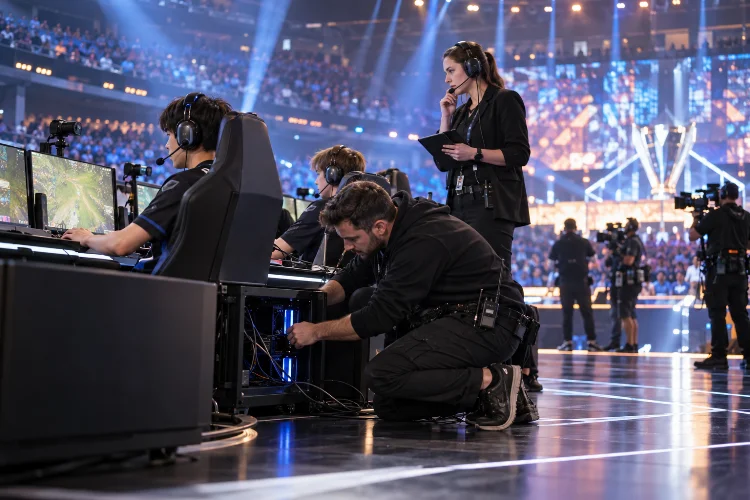
Imagine organizing a major esports championship featuring some of the world’s most talented professional players. Thousands of fans are watching online, the arena is packed with excited spectators, and every match carries enormous competitive pressure.
Everything looks incredible until something unexpected happens.
A player’s computer suddenly disconnects, the livestream experiences technical difficulties, and the tournament schedule starts falling apart. Meanwhile, your production team is scrambling to fix problems while everyone waits for the action to resume.
Sounds stressful, right?
Welcome to the complicated world of professional esports event management.
Behind every successful tournament is an enormous amount of planning, coordination, technical preparation, and real-time decision-making.
That’s why optimizing esports event operations for professional competitions has become increasingly important for tournament organizers, production companies, gaming organizations, and esports businesses.
Running a successful championship isn’t simply about inviting talented players and providing powerful gaming computers.
It’s about creating a reliable competitive environment where players perform fairly, spectators enjoy the experience, and operational problems are handled efficiently.
Let’s explore the strategies, technologies, and management practices that help professional esports events run smoothly from preparation to the final trophy presentation.
1. Build a Strong Esports Event Planning Framework
Successful esports tournaments begin long before players arrive at the competition venue.
Every major operational decision, from tournament structure to equipment requirements, should support a clearly defined event strategy.
Without proper planning, even an exciting tournament concept can become an expensive logistical nightmare.
Define Clear Objectives and Tournament Requirements
Before organizing an event, determine exactly what you’re trying to accomplish.
Are you hosting a regional championship, an international professional competition, or an invitational tournament designed to attract a global streaming audience?
Each format creates different operational requirements.
A small online tournament might prioritize stable servers, efficient registration, and automated brackets. A large arena competition requires additional planning for physical security, broadcasting infrastructure, hospitality, and spectator management.
Your objectives should also influence budget allocation.
For example, an event focused on international streaming may need to prioritize broadcast production, multilingual commentary, and reliable internet connectivity.
An arena-focused event might allocate more resources toward stage design, audience seating, and live entertainment.
The goal is to avoid spending heavily on features that don’t support the event’s main purpose.
Establish Licensing and Legal Requirements Early
One commonly overlooked aspect of esports tournament organization involves intellectual property rights.
Unlike traditional sports, competitive video games are owned by publishers that may control how their titles are used in commercial competitions.
The World Intellectual Property Organization’s Guidelines for Esports Tournament Organizers explain that organizers may need appropriate permissions covering game usage, broadcasting, sponsorship, and promotional materials.
These requirements depend on the publisher and event format.
Before announcing your championship, review the game’s community competition policies and determine whether additional authorization is necessary.
Doing this early helps prevent complications after sponsors, teams, and spectators have already committed.
2. Create Reliable Tournament Rules and Competitive Integrity Systems
Fair competition is the foundation of professional esports.
Players need confidence that matches are conducted consistently, disputes receive appropriate attention, and every participating team follows the same standards.
Without that trust, tournament credibility can disappear quickly.
Develop Comprehensive Competition Rules
Your tournament rulebook should explain exactly how the competition operates.
This includes tournament formats, player eligibility, roster requirements, match procedures, equipment policies, technical pauses, and disciplinary actions.
Consider a situation where a player disconnects during a decisive round.
Should the match continue, pause, or restart?
The answer should come from established rules rather than an improvised decision made under pressure.
Platforms such as FACEIT provide tournament rule-management tools, allowing organizers to prepare and publish structured competition guidelines.
A professional rulebook should also explain who has authority to interpret rules and how participants can challenge decisions.
Clear procedures reduce confusion and make difficult situations easier to manage.
Protect Competitive Integrity
Professional tournaments must also address cheating, match manipulation, harassment, and conflicts of interest.
The Esports Integrity Commission (ESIC) maintains codes addressing ethical conduct, corruption, anti-doping, and disciplinary procedures.
These resources provide useful reference points for organizers developing integrity policies.
Practical safeguards can include verified player identities, anti-cheat requirements, controlled competition equipment, referee supervision, and documented incident reporting.
Tournament staff should also understand how to preserve evidence when potential violations occur.
Importantly, enforcement needs to be fair and consistant.
A rule applied strictly to one team but ignored for another can seriously damage trust.
Learn From Established Esports Organizations
Major esports ecosystems invest heavily in competition governance.
For example, Riot Games’ Competitive Operations Library provides official regulations for its esports titles, including 2026 competition policies and rulesets.
These documents illustrate how professional leagues formalize participant responsibilities, competitive standards, and disciplinary procedures.
Smaller organizers don’t need to copy every professional league regulation.
However, they can learn from the principle of maintaining transparent, accessible, and consistently enforced rules.
3. Optimize Tournament Scheduling and Team Coordination
Few things frustrate professional players and esports audiences more than constant delays.
Unpredictable scheduling affects team preparation, broadcasting plans, venue operations, and the overall spectator experience.
An efficient tournament schedule needs to balance competitive requirements with realistic operational capacity.
Design a Realistic Match Schedule
Tournament organizers should begin by estimating how long each match or series could take.
A best-of-three series requires considerably more scheduling flexibility than a single-game elimination match.
You also need time for player setup, referee checks, breaks, interviews, broadcast transitions, and unexpected technical interruptions.
Imagine organizing a Counter-Strike 2 championship with multiple best-of-three matches.
If every match is scheduled using only its shortest possible duration, one closely contested series could disrupt the entire day.
A better approach involves creating contingency buffers between important sessions.
These buffers provide room for overtime, equipment adjustments, and unavoidable delays.
The objective isn’t to fill every available minute.
It’s to create a schedule that can survive normal tournament uncertainty.
Centralize Operational Communication
Large competitions involve numerous teams working simultaneously.
Tournament administrators manage competitive rules, technical specialists maintain equipment, production crews oversee broadcasts, and hospitality coordinators support participants.
Without clear communication, small issues can quickly become larger problems.
Create a centralized operations structure with clearly assigned responsibilities.
For example, a technical issue affecting a player’s computer should reach the appropriate technician immediately, while the head referee determines whether a match pause is necessary.
The broadcast director then needs to know how the interruption affects live programming.
This seperation of responsibilities prevents unnecessary confusion.
Prepare Teams Before Match Day
Player preparation is another important component of tournament efficiency.
Participants should recieve match schedules, check-in instructions, technical requirements, and competition rules before the event begins.
For offline tournaments, confirm travel arrangements, accommodation details, practice-room access, and arrival procedures.
International competitions may require additional support involving visas, equipment transportation, and local transportation.
The earlier these arrangements are confirmed, the fewer surprises organizers encounter during competition.
Professional players should be focused on performing, not solving preventable logistical problems.
4. Strengthen Technical Infrastructure and Emergency Readiness
Technical reliability is one of the biggest operational challenges in professional esports.
A visually impressive stage means very little if gaming stations constantly malfunction or network problems interrupt important matches.
That’s why infrastructure planning deserves serious attention.
Standardize Gaming Equipment
Professional competitors need a stable and predictable playing environment.
For PC-based tournaments, organizers should establish consistent hardware specifications, operating system configurations, graphics settings, and network conditions.
Depending on publisher rules, players may be permitted to use approved personal peripherals.
However, those devices should be checked for compatibility before competition begins.
Standardized systems reduce unexpected differences between gaming stations.
They also make technical troubleshooting easier because technicians are working with familiar configurations.
Build Reliable Network Infrastructure
Online and offline tournaments have different connectivity requirements.
Online events depend heavily on server selection, geographic latency, routing stability, and the reliability of participants’ internet connections.
LAN competitions require carefully managed local networks while potentially relying on external connectivity for game services, authentication, or broadcast delivery.
Where practical, seperate competition traffic from public Wi-Fi and nonessential production systems.
Network engineers should monitor latency, packet loss, bandwidth usage, and connection stability during rehearsals and live matches.
Redundant connections and backup equipment can reduce the impact of certain failures, although their effectiveness depends on the specific game architecture and venue.
Prepare Technical Contingency Plans
Even excellent infrastructure can’t eliminate every possible failure.
A monitor might stop working, a game client could crash, or a production computer might unexpectedly restart.
The important question is how quickly and fairly your team can respond.
Develop a technical incident-response plan before the event.
For example, a hardware failure might trigger a referee-approved pause, immediate equipment inspection, replacement with a tested spare, and confirmation that competitive conditions have been restored.
Each stage should have a responsible person.
You should also establish procedures for more serious incidents, including venue power problems, security threats, and extended network outages.
Run realistic rehearsals rather than assuming emergency procedures will work automatically.
5. Improve Esports Broadcasting and Live Production Quality
Professional esports events aren’t just competitions.
They’re also entertainment experiences watched by audiences across streaming platforms, social media, and sometimes traditional broadcast channels.
The quality of the broadcast influences how viewers experience the tournament.
Develop a Coordinated Production Workflow
A successful esports broadcast usually involves observers, commentators, audio engineers, graphics operators, replay specialists, and a production director.
Each role contributes to presenting the competition clearly.
Observers choose which in-game perspectives viewers see, while commentators explain the action and build excitement.
Production teams handle transitions between gameplay, interviews, analysis segments, and commercial breaks.
Strong coordination ensures those elements feel connected rather than chaotic.
For example, when a match ends unexpectedly, the production director should be able to transition smoothly into an appropriate replay or analysis segment.
A clear production rundown helps everyone understand what happens next.
Prioritize Stream Stability Over Maximum Resolution
High-resolution video looks attractive, but streaming reliability matters more than impressive technical specifications.
A beautiful broadcast that freezes repeatedly creates a frustrating viewing experience.
Twitch’s Enhanced Broadcasting documentation explains how multiple video quality options can help viewers with different internet speeds and devices.
This flexibility is particularly valuable for international esports audiences.
Organizers should choose encoding settings based on available bandwidth, production hardware, and audience requirements.
Don’t assume the highest possible resolution automatically delivers the best results.
Monitor Broadcast Health in Real Time
Broadcast monitoring should continue throughout the entire tournament.
Technical staff need to watch for unstable bitrates, dropped frames, audio problems, and interruptions.
Twitch provides a Guide to Using Twitch Inspector, which explains how broadcasters can review streaming health, technical specifications, and unstable events.
These monitoring principles are relevant to professional production environments beyond a single platform.
It is also useful to maintain independent recording systems so important footage remains available when streaming services encounter problems.
When an issue occurs, the production team should follow an established communication procedure.
Viewers are generally more understanding of a technical interruption when organizers explain the situation clearly.
6. Enhance the Live Audience, Player, and Sponsor Experience
Operational excellence isn’t limited to match administration.
Professional esports events also involve spectators, sponsors, media representatives, players, coaches, and venue personnel.
Each group has different expectations.
A successful event should provide a positive experience without compromising competitive fairness.
Design a Comfortable Spectator Experience
For arena tournaments, audience experience begins before the first match starts.
Ticketing procedures, entrances, seating arrangements, signage, and transportation information all affect how smoothly spectators arrive.
Inside the venue, large screens should provide clear visibility from different seating sections.
Audio systems should deliver exciting commentary without creating unnecessary discomfort.
Organizers should also consider accessible seating, crowd movement, restroom facilities, medical assistance, and emergency exits.
These details might not appear in tournament highlight videos, but they influence the overall event experience.
Protect Competitive Conditions
Audience entertainment must never interfere with fair competition.
For example, loud spectator reactions may unintentionally provide information to players if the stage lacks appropriate sound isolation.
Professional competitions may use sound-isolating equipment, controlled player areas, and other measures to reduce external interference.
The precise safeguards should follow publisher requirements and the event’s competitive rules.
Similarly, player preparation areas should remain appropriately separated from public spaces.
Clear access-control procedures help prevent unwanted interruptions.
Deliver Meaningful Sponsor Integration
Sponsors play an important role in financing esports competitions.
However, excessive advertising can damage the viewing experience.
Instead of interrupting every exciting moment with promotions, integrate sponsors into appropriate parts of the event.
These might include branded analysis segments, interactive fan experiences, merchandise areas, or sponsored interviews.
Sponsor activations should respect publisher licensing conditions, commercial agreements, and relevant advertising rules.
A useful approach is to evaluate sponsorship performance through measurable indicators such as engagement, attendance, exposure, and campaign participation.
That creates more value than relying exclusively on logo placement.
7. Use Data and Post-Event Analysis to Improve Future Tournaments
Once the championship ends, operational improvement shouldn’t stop.
The final trophy presentation might mark the end of the competition, but it also creates an opportunity to evaluate what worked and what needs improvement.
The most reliable tournament organizers use evidence rather than assumptions.
Track Meaningful Operational KPIs
Key performance indicators help event managers assess different parts of tournament operations.
For scheduling, useful measurements include match start-time accuracy, total delays, and average interruption duration.
Technical teams might track equipment failures, network incidents, and time required to restore services.
Broadcast teams can monitor stream stability, viewer retention, and production errors.
Audience-related metrics may include attendance, ticket scanning delays, accessibility feedback, and spectator satisfaction.
Financial indicators might cover revenue, operational costs, sponsorship delivery, and budget variance.
However, avoid collecting statistics simply because they’re available.
Every metric should help answer a meaningful operational question.
Conduct Structured Post-Event Reviews
Within a few days of the competition, gather feedback from the teams responsible for major operational areas.
Review tournament administration, broadcast production, technical infrastructure, venue management, player services, and sponsor activities.
Identify which issues occurred repeatedly and which were isolated incidents.
For example, if several matches started late because player equipment checks took longer than expected, the next event might benefit from an earlier check-in window.
If broadcast interruptions were caused by unstable connections, infrastructure improvements may become a higher priority.
Document each problem alongside its likely cause, responsible department, and recommended solution.
This creates a practical improvement plan rather than a collection of vague complaints.
Introduce Automation Carefully
Tournament management platforms can automate useful administrative tasks.
These may include registration, bracket generation, match notifications, score reporting, and participant check-ins.
Automation can reduce manual workload and improve consistency.
However, important competitive decisions should still have appropriate human oversight.
A system might automatically update tournament standings, but disputed results or unusual incidents may require referee review.
Technology works best when it supports trained event personnel instead of replacing essential judgment.
Create Repeatable Operating Procedures
The final step is turning experience into repeatable processes.
Build standard operating procedures for equipment inspections, player check-ins, technical pauses, broadcast transitions, emergency response, and tournament reporting.
These documents should remain accessible and recieve updates when regulations, technology, or operational requirements change.
For example, the Esports World Cup’s 2026 Resource Center centralizes competition rulebooks, rulings, player-related information, media resources, and other event materials.
This demonstrates the practical value of organized documentation in large, multi-title competitions.
A clear operational knowledge base makes it easier to train new staff and maintain consistency between events.
Ultimately, successful esports event management is a process of continuous refinement.
Each competition provides new insights that can make the next one more reliable, efficient, and enjoyable.
Optimizing esports event operations for professional competitions requires much more than organizing matches and creating an exciting stage.
Successful tournaments depend on careful planning, transparent regulations, reliable technical infrastructure, coordinated production teams, and strong communication.
Organizers must also consider player welfare, spectator satisfaction, sponsorship commitments, and effective incident management.
When these elements work together, competitions become more professional, predictable, and engaging for everyone involved.
The most important lesson is that operational excellence doesn’t happen accidentally.
It develops through preparation, testing, documentation, and continuous improvement.
Whether you’re organizing a regional tournament or preparing an international championship, start by identifying your biggest operational risks and building clear solutions.
Ready to host a better esports event? Strengthen your planning systems, improve team coordination, and turn your next tournament into a professionally managed competitive experience.