
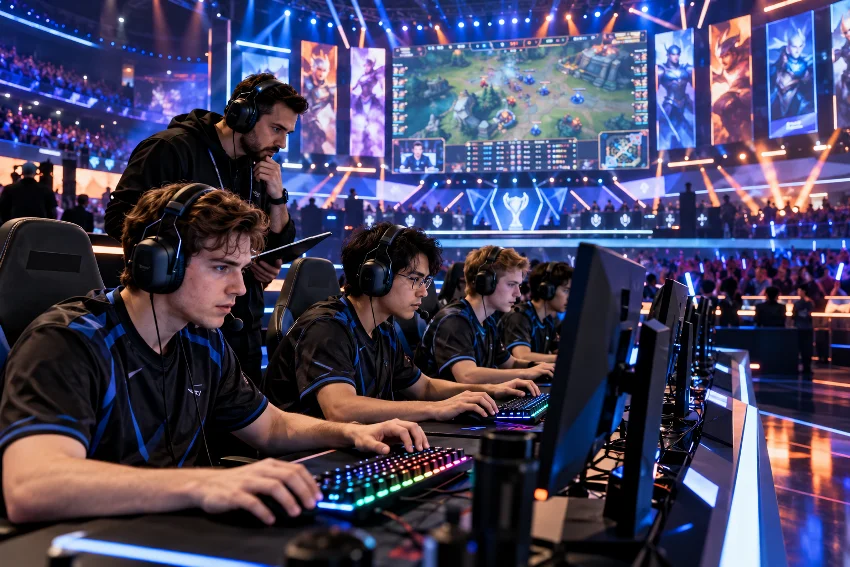
Winning a competitive video game takes more than fast reflexes and an expensive gaming setup. Behind every impressive tournament victory lies a combination of strategy, communication, discipline, and countless hours of meaningful practice. That’s what makes Gaming and Esports such a fascinating competitive environment.
From tactical shooters and multiplayer battle arenas to mobile esports and professional gaming leagues, digital competition continues to attract ambitious players worldwide.
Whether you’re climbing ranked leaderboards, building a competitive team, or considering a professional career, understanding advanced performance principles can make a real difference.
This guide explores the skills, systems, and strategies behind consistent competitive excellence.
1. Understanding the Evolution of Competitive Gaming
Competitive gaming has developed from informal arcade challenges into an organized entertainment industry featuring international tournaments, professional organizations, coaching teams, and dedicated broadcasting platforms.
Modern players compete in structured environments where technical skill, preparation, and tactical decisions influence outcomes.
From Arcade Competition to Professional Esports
Early video game competitions were largely centered around arcade machines, high scores, and local gaming communities.
As personal computers, consoles, and online multiplayer technology developed, competitive opportunities expanded.
Games could now connect players across different locations, allowing organized teams and regional communities to emerge.
The popularity of high-speed internet and livestreaming subsequently made competitive matches accessible to audiences far beyond physical tournament venues.
Today, esports includes professional leagues, independent tournaments, grassroots competitions, and international championships.
The Esports World Cup’s 2026 competitive operations resources, for example, provide rulebooks for 25 game titles across multiple genres.
This diversity illustrates how competitive gaming extends far beyond one title or platform.
Major Competitive Gaming Genres
Different esports genres demand different combinations of mechanical execution, strategy, and teamwork.
First-person shooters such as Counter-Strike 2 and VALORANT emphasize aiming precision, positioning, timing, and tactical coordination.
Multiplayer online battle arena games, including League of Legends and Dota 2, place greater emphasis on character selection, resource management, team objectives, and large-scale engagements.
Battle royale games challenge players to adapt to changing environments, uncertain encounters, and survival-based objectives.
Fighting games such as Street Fighter 6 reward matchup knowledge, spacing, defensive awareness, and precise execution.
Mobile competitions, including Mobile Legends: Bang Bang, have also made organized competitive play accessible through smartphones.
Despite their differences, these genres share one important characteristic: consistent improvement requires deliberate skill development.
The Difference Between Casual and Competitive Play
Casual gaming primarily emphasizes enjoyment, exploration, and entertainment.
Competitive play introduces clearly defined performance objectives.
A casual player might choose a character because its visual design looks interesting, while a tournament participant evaluates how that character contributes to team strategy.
Competitive players also review mistakes, study opponents, and develop repeatable decision-making processes.
However, enjoying competition doesn’t require becoming a professional athlete.
Ranked matches, amateur tournaments, and local gaming communities can provide rewarding experiences without the intense demands of full-time competition.
2. Developing Advanced Mechanical Skills and Game Awareness
Mechanical ability remains an important part of competitive performance.
However, fast reactions alone rarely determine success in complex multiplayer games.
Experienced competitors combine execution with anticipation, positioning, and an understanding of the game’s underlying systems.
Improving Aim, Accuracy, and Reaction Control
In tactical shooters, aiming accuracy depends on several interconnected skills.
Crosshair placement, movement control, target recognition, and recoil management all contribute to successful engagements.
A player who consistently positions their crosshair near likely enemy locations may need fewer large aiming adjustments.
This can be more effective than relying exclusively on raw reaction speed.
Training should therefore involve realistic situations rather than endless random clicking exercises.
For example, a focused practice session might involve tracking moving targets, controlling recoil patterns, and rehearsing common engagement angles.
The goal is to improve accuracy under conditions that resemble actual gameplay.
Understanding Game Sense and Tactical Awareness
Game sense describes a player’s ability to interpret unfolding situations and anticipate likely outcomes.
It develops through experience, knowledge, and careful analysis.
In a multiplayer battle arena, strong game awareness includes monitoring enemy positions, recognizing objective timers, and understanding when to engage or retreat.
In a tactical shooter, players must interpret footsteps, utility usage, teammate information, and previous opponent behavior.
These decisions often happen within seconds.
Skilled competitors develop mental patterns that help them process information efficiently.
Rather than reacting to every situation independently, they recognize familiar scenarios and select appropriate responses.
Decision-Making Under Pressure
Competitive matches frequently create situations where players must choose between several imperfect options.
Imagine a team defending a critical objective with limited resources.
One player might attempt an aggressive elimination, while another could prioritize delaying the opponent until teammates arrive.
The better decision depends on available information, team composition, timing, and the match situation.
A successful result doesn’t necessarily mean the original decision was optimal.
Sometimes, a risky move works because an opponent makes a mistake.
Strong analytical practice therefore evaluates decision quality separately from the final outcome.
Learning From Gameplay Reviews
Reviewing recorded matches is one of the most practical ways to identify recurring performance problems.
Instead of concentrating only on missed shots, examine decisions leading up to each encounter.
Was the player positioned correctly? Was the fight necessary? Did teammates communicate useful information?
These questions reveal weaknesses that mechanical practice alone may not solve.
A useful approach is to identify one recurring problem after every review and focus on improving that behavior during subsequent sessions.
Gradual, targeted improvement often produces more reliable progress than attempting to correct every mistake simultaneously.
3. Team Strategy, Communication, and Tactical Coordination
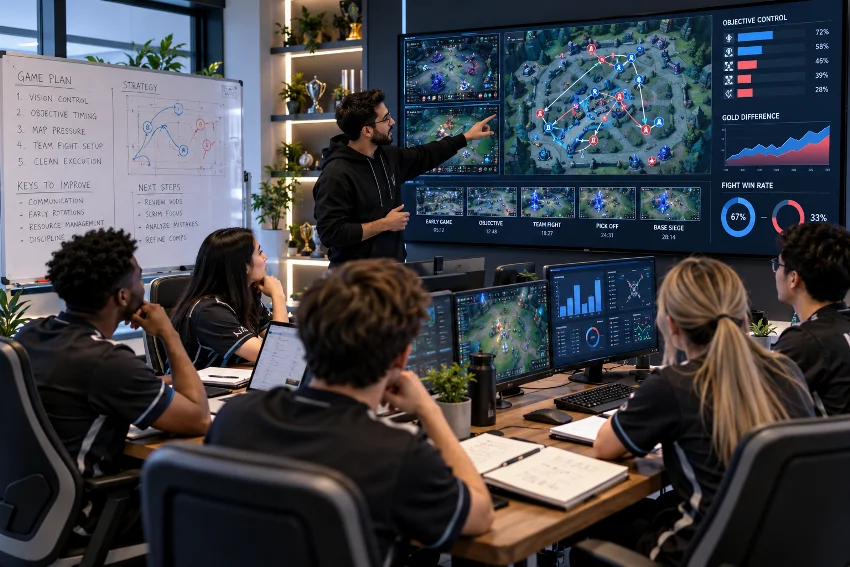
Individual skill can win isolated encounters, but consistent team success requires coordinated decisions.
Professional esports organizations depend on players understanding their responsibilities and responding effectively to shared information.
Good teamwork isn’t about everyone making the same decisions.
It’s about combining different roles into one coherent strategy.
Establishing Clear Team Roles
Team roles vary across competitive titles.
A tactical shooter may feature entry players, support specialists, defensive anchors, and in-game leaders.
A multiplayer battle arena commonly organizes responsibilities around lanes, jungle control, support functions, and resource distribution.
These roles help teams divide responsibilities without duplicating unnecessary actions.
For example, an entry player may initiate an engagement while supporting teammates provide utility and trade opportunities.
Successful coordination depends on each player understanding the intended sequence.
However, rigid role assignments can become limiting.
Teams should also develop flexibility so players can respond when unexpected situations disrupt the original plan.
Effective In-Game Communication
Communication quality matters more than communication volume.
During high-pressure situations, long explanations can distract teammates from immediate decisions.
Short, accurate callouts are usually more useful.
A player might communicate an enemy’s location, remaining resources, and immediate threat level.
The information should be specific enough to guide action without creating unnecessary confusion.
Teams can improve through shared terminology and agreed communication priorities.
Post-match discussions should provide opportunities for more detailed explanation.
Building Team Chemistry and Trust
Strong teams require mutual confidence.
Players need to trust that teammates will communicate accurately, fulfill responsibilities, and respond constructively to mistakes.
This trust develops through repeated practice and consistent behavior.
Blaming individual players after every lost round can weaken communication and discourage responsible decision-making.
Effective teams examine mistakes without turning every review into personal criticism.
For example, a failed objective attempt may result from poor timing, incomplete information, and unclear leadership rather than one player’s mechanical error.
Addressing the shared causes produces more useful lessons.
Advanced Drafting and Opponent Preparation
In character-based competitive games, drafting can influence a match before active gameplay begins.
Teams select characters, heroes, or champions based on strategic needs and the opponent’s likely approach.
A strong draft considers synergy, counters, flexibility, and individual player expertise.
However, selecting statistically popular characters doesn’t guarantee a favorable result.
Players must still understand how to execute the composition.
Opponent preparation also involves studying previous matches to identify recurring patterns.
An analyst may discover that a particular team frequently prioritizes early objectives or prefers defensive positioning after gaining an advantage.
These observations can inform preparation without assuming that opponents will always repeat previous strategies.
4. Professional Esports Training and Performance Development
Professional improvement requires more than playing ranked matches for as many hours as possible.
A structured training program combines mechanical practice, tactical development, review sessions, and recovery.
The purpose is to make each session contribute toward a measurable objective.
Designing a Deliberate Practice Routine
Deliberate practice focuses on clearly identified weaknesses.
For example, a player struggling with defensive positioning might spend several sessions studying common map angles and rehearsing safer movement patterns.
Simply playing another twenty matches without evaluating those decisions may reinforce existing mistakes.
A productive routine separates different training objectives.
Mechanical drills develop execution, tactical exercises improve decision-making, and scrimmages test both skills under competitive pressure.
Review sessions then identify what should change.
This approach turns daily practice into a cycle of observation, adjustment, and improvement.
Balancing Solo Practice and Team Scrimmages
Solo practice is useful for skills that can be developed independently.
These include aiming fundamentals, character-specific combinations, movement execution, and familiarity with game mechanics.
Team scrimmages develop coordination under conditions that resemble organized competition.
Players must communicate, adapt to opponents, and execute shared strategies.
Neither approach completely replaces the other.
An excellent individual player may struggle in team competition without sufficient coordination experience.
Likewise, a well-organized team can be limited by inconsistent mechanical execution.
The strongest training programs develop both dimensions.
Example Weekly Competitive Training Plan
A practical schedule should account for experience, tournament demands, and responsibilities outside gaming.
The following example represents a moderate training structure for an experienced amateur team, not a required professional workload.
| Day | Training Focus | Main Activity |
|---|---|---|
| Monday | Mechanical Development | Aim, Movement, Technical Execution |
| Tuesday | Tactical Awareness | Map Study, Decision Reviews |
| Wednesday | Team Coordination | Communication Drills, Scrimmages |
| Thursday | Opponent Analysis | Replay Study, Draft Preparation |
| Friday | Competitive Simulation | Structured Practice Matches |
| Saturday | Performance Review | Mistake Analysis, Targeted Drills |
| Sunday | Recovery | Rest and Light Recreation |
Training intensity should be adjusted when fatigue, academic obligations, work responsibilities, or tournaments create additional demands.
The objective is consistent learning rather than maximising screen time.
Tracking Competitive Performance
Performance data helps players distinguish genuine progress from temporary winning streaks.
Useful metrics vary by game.
A shooter might track opening engagements, damage efficiency, positioning mistakes, and utility effectiveness.
A strategy-based player may monitor resource management, objective involvement, and decision timing.
However, statistics without context can be misleading.
A player with fewer eliminations might still provide exceptional strategic value through positioning, communication, or support.
Performance reviews should combine quantitative measurements with qualitative analysis.
This creates a more balanced understanding of competitive contribution.
5. Gaming Equipment, Optimization, and Technical Performance
Competitive performance depends partly on the relationship between player skill and technical equipment.
Reliable hardware helps ensure that intended actions are reproduced consistently during gameplay.
However, expensive devices cannot compensate for weak decision-making or insufficient practice.
Refresh Rates, Frame Rates, and Display Responsiveness
Display refresh rate describes how frequently a monitor updates its image.
A 144 Hz display can refresh up to 144 times per second, while a 240 Hz display supports up to 240 updates per second.
Higher refresh rates can provide smoother visual feedback when the game and computer deliver sufficient frames.
However, improvements become increasingly dependent on the player’s hardware, game engine, settings, and sensitivity to latency.
System latency is particularly important in competitive titles.
NVIDIA explains that its Reflex technologies help developers measure and reduce delays between input and the resulting displayed action.
Players should prioritize stable performance over graphics settings that introduce unnecessary stuttering.
Choosing the Right Mouse, Keyboard, and Controller
Gaming peripherals influence comfort, consistency, and precision.
A suitable mouse should accommodate the player’s grip and preferred sensitivity.
Keyboard responsiveness, controller layout, and input customization can also affect execution.
Nevertheless, changing equipment constantly may disrupt established muscle memory.
Players should test settings carefully and allow sufficient time to adapt.
The most effective device is usually one that feels comfortable, functions reliably, and supports consistent inputs.
Brand reputation alone doesn’t guarantee superior competitive results.
Network Stability and Input Latency
Online competition requires reliable network connectivity.
High latency can delay communication between a player’s device and the game server.
Packet loss and unstable connections may cause inconsistent movement or delayed feedback.
A wired connection may provide greater stability than wireless networking in some environments.
Players should also investigate background downloads, router limitations, and server selection.
Reducing unnecessary technical uncertainty allows competitors to focus on actual gameplay decisions.
6. Physical Health, Mental Resilience, and Player Recovery
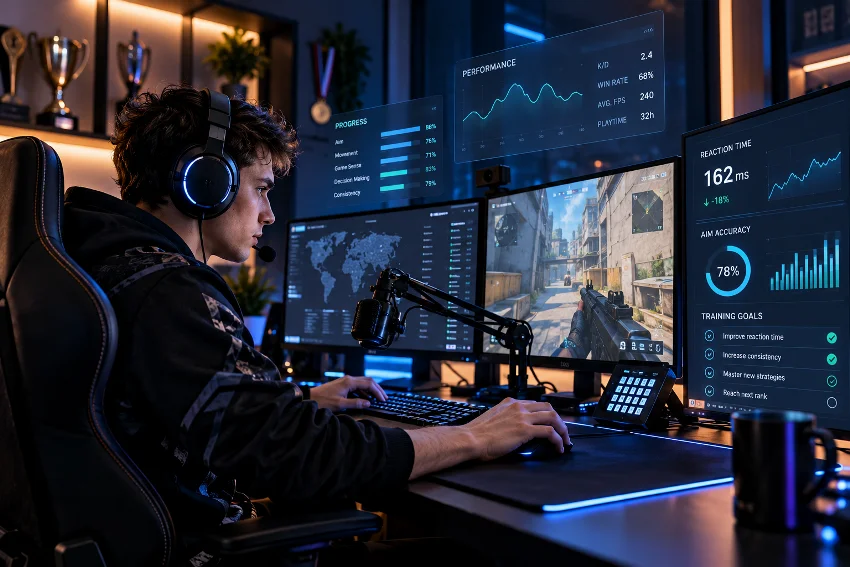
Competitive gaming places significant demands on attention, concentration, and repetitive physical movements.
Although esports doesn’t involve the same physical requirements as traditional field sports, player well-being remains important.
Long sessions without appropriate recovery can create avoidable health problems.
Sleep and Cognitive Performance
Sleep supports attention, emotional regulation, memory, and everyday functioning.
These capabilities are relevant to decision-making during competitive matches.
A study involving 27 Counter-Strike players monitored sleep patterns over 56 days and identified sleep characteristics below recommended levels.
However, research findings should be interpreted carefully.
Another study involving 40 Rocket League players found that approximately 29 hours of sleep deprivation worsened several cognitive measures without significantly reducing overall in-game performance in that experiment.
These results highlight the complexity of measuring competitive performance.
They do not establish that sleep deprivation is harmless or that players should sacrifice sleep for practice.
Consistent sleep habits remain an important part of a sustainable training routine.
Preventing Repetitive Strain and Physical Discomfort
Extended gaming sessions involve prolonged sitting and repeated hand movements.
These demands may contribute to discomfort involving the neck, shoulders, back, wrists, or hands.
A 2026 systematic review of professional esports players found substantial variation in reported musculoskeletal symptoms across the studies examined.
Players can reduce unnecessary strain by adjusting workstation ergonomics, changing positions regularly, and taking movement breaks.
Chair height, monitor positioning, desk configuration, and controller comfort all deserve attention.
Persistent pain should be assessed by a qualified healthcare professional rather than ignored or treated through additional practice.
Physical Exercise and Competitive Readiness
Physical exercise supports general health and may also contribute to abilities relevant to esports performance.
A 2026 systematic review examined twelve experimental studies involving physical exercise interventions among competitive players.
It reported beneficial findings for several outcomes, including aspects of reaction time, aiming accuracy, and executive functioning, while noting that long-term evidence remains mixed.
Activities such as walking, cycling, resistance training, and recreational sports can therefore complement gaming routines.
The most appropriate activity depends on individual fitness, available time, and personal preferences.
Physical training should support well-being rather than become another source of excessive pressure.
Managing Competitive Stress and Burnout
Tournament environments can create intense emotional demands.
Players may experience frustration after repeated losses, anxiety before important matches, or pressure from audience expectations.
Mental resilience involves developing healthy responses to these challenges.
Useful techniques include structured preparation, realistic goals, supportive coaching, and reviewing mistakes without excessive self-criticism.
Burnout may develop when prolonged demands exceed available recovery resources.
Warning signs can include persistent exhaustion, declining motivation, and growing resentment toward previously enjoyable activities.
The World Health Organization also recognizes gaming disorder as a distinct condition involving impaired control and significant functional impairment, but emphasizes that it affects only a small proportion of people who play games.
Healthy competitive participation should remain compatible with education, employment, relationships, and personal well-being.
7. Esports Careers, Tournament Integrity, and Industry Development
For talented competitors, organized esports can create opportunities beyond recreational gaming.
However, professional careers require more than exceptional rankings.
Players must understand team expectations, competition rules, financial arrangements, and the broader entertainment ecosystem.
Building a Professional Gaming Career
Aspiring professionals often begin through ranked ladders, community tournaments, collegiate programs, or regional competitions.
Consistent performance may attract attention from amateur teams or organizations looking for developing talent.
However, a high ranking doesn’t automatically guarantee recruitment.
Teams also consider communication skills, adaptability, reliability, and how players behave under pressure.
Building a useful competitive portfolio can help.
This might include tournament history, representative gameplay recordings, clearly presented statistics, and evidence of teamwork.
Players should avoid exaggerating results or presenting misleading performance data.
Professional credibility depends on consistency both inside and outside matches.
Coaching, Analytics, and Content Creation
The esports industry supports multiple roles beyond professional players.
Coaches help improve performance, develop strategies, and coordinate team preparation.
Analysts examine match patterns, opponents, and performance data.
Broadcast professionals, tournament administrators, production teams, designers, and community managers contribute to the wider competitive environment.
Content creation offers another path for individuals who enjoy explaining strategies, reviewing matches, or entertaining gaming audiences.
However, income from streaming and sponsorships can be unpredictable.
A sustainable career plan should include practical financial expectations and transferable professional skills.
Tournament Rules and Competitive Integrity
Fair competition is essential to maintaining audience confidence.
Esports events use formal regulations covering player eligibility, prohibited behavior, match administration, and disciplinary procedures.
Riot Games’ 2026 competitive operations library includes a global code of conduct and competition-specific rules for its major esports titles.
Players should read applicable rulebooks before participating in organized events.
Account sharing, prohibited software, match manipulation, and inappropriate conduct can lead to serious consequences.
Teams should also review contract conditions and understand how prize distribution, sponsorship responsibilities, and roster changes are handled.
Professional conduct is a competitive asset, not simply an administrative obligation.
The Future of Competitive Gaming
Competitive gaming will continue adapting to new technologies, changing audience preferences, and evolving game ecosystems.
Mobile competitions have increased access to organized play in regions where smartphones are more widely available than powerful gaming computers.
Improved broadcasting tools and performance analytics may also expand opportunities for coaches, event organizers, and independent creators.
However, growth isn’t guaranteed for every game or tournament.
Successful esports ecosystems require active communities, consistent competition formats, responsible financial management, and credible governance.
The strongest long-term opportunities will likely emerge where entertaining competition and sustainable industry practices reinforce each other.
Gaming and Esports excellence depends on much more than mechanical talent. Strategic thinking, disciplined practise, reliable equipment, teamwork, and healthy recovery all contribute to sustainable competitive growth.
Whether you’re chasing a higher rank or preparing for professional tournaments, focus on measurable improvement instead of endless grinding. Build a structured training routine, review your performence regularly, and take the next step toward becoming a more consistant competitor.