
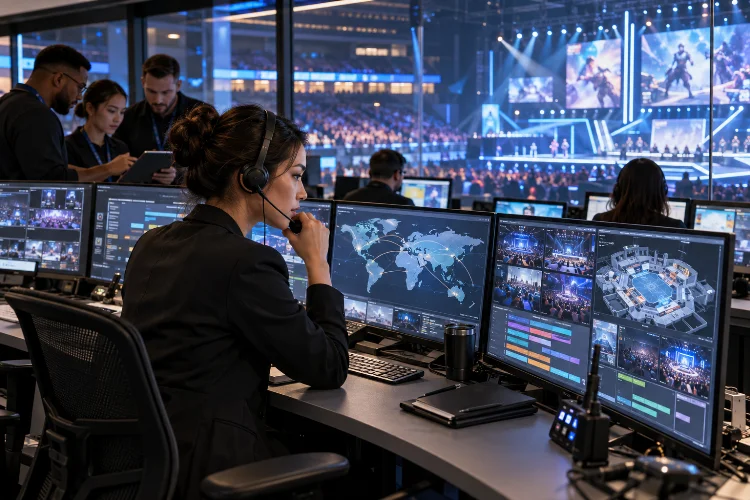
Imagine organizing an international esports tournament featuring dozens of professional teams, thousands of spectators, millions of potential online viewers, and players arriving from multiple continents.
Sounds exciting, right?
Now imagine coordinating every match schedule, managing international travel, maintaining stable gaming servers, preventing cheating, satisfying sponsors, and delivering flawless live broadcasts.
Suddenly, organizing an esports tournament looks a lot more complicated than simply setting up computers and letting players compete.
That’s where advanced esports tournament management becomes essential.
Professional esports events have evolved into sophisticated international productions requiring careful planning, technical expertise, financial oversight, and coordination between numerous stakeholders.
Major competitions involving games like Counter-Strike 2, League of Legends, Dota 2, and VALORANT demonstrate how competitive gaming has become a serious global entertainment industry.
But behind every memorable championship moment is an extensive operational system keeping everything running smoothly.
In this guide, we’ll explore the strategies, technologies, and management principles that help organizers deliver successful international esports competitions while maintaining competitive integrity, operational efficiency, and an engaging experience for players and fans.
1. Building a Strong Foundation for Global Esports Tournament Management
Every successful international esports event begins with a clear organizational framework.
Without proper planning, even tournaments supported by significant financial resources can experience scheduling problems, technical failures, and communication breakdowns.
Defining Tournament Objectives and Competitive Scope
Before selecting venues or announcing prize pools, organizers need to establish what the competition is trying to achieve.
Some tournaments focus on identifying the strongest professional teams, while others prioritize regional talent development, community engagement, or commercial growth.
These objectives influence almost every operational decision.
For example, a championship designed to showcase emerging talent might prioritize accessible qualification pathways and regional representation.
Meanwhile, an elite invitational event may emphasize established competitive rankings, broadcast production, and partnerships with professional organizations.
Neither approach is inherently better.
The important thing is making sure the tournament structure supports its intended purpose.
Creating an Organizational Management Structure
Large esports competitions require specialized teams responsible for different aspects of event delivery.
Competition administrators manage regulations, match schedules, and competitive disputes.
Technical teams oversee gaming equipment, network infrastructure, server performance, and cybersecurity.
Meanwhile, production specialists handle broadcasting, stage design, commentary, and audience experiences.
Commercial departments coordinate sponsorships, ticketing, partnerships, and promotional campaigns.
A central tournament director connects these departments and ensures that major decisions follow a consistent operational strategy.
Clear responsibility assignments prevent situations where multiple teams assume someone else is handling an important task.
One practical approach is establishing a responsibility matrix identifying who makes decisions, who approves changes, and who must be informed.
This becomes particularly valuable when managing international partners working across different time zones.
2. Designing Competitive Formats and International Qualification Systems
Tournament formats have a major influence on competitive fairness, scheduling requirements, and audience engagement.
Choosing the wrong structure can create unnecessary delays or produce results that don’t accurately reflect team performance.
Choosing Between Different Tournament Formats
Single-elimination tournaments are relatively straightforward.
Once a team loses, its tournament journey ends.
This format reduces the number of matches and makes scheduling easier, but one unfortunate performance can eliminate an otherwise strong competitor.
Double-elimination systems provide a second opportunity through lower brackets.
They’re popular in several competitive gaming communities because they reduce the consequences of a single defeat.
However, additional matches require more production time, staff availability, and scheduling flexibility.
Round-robin systems allow teams to compete against every opponent within a group.
For example, a hypothetical tournament featuring 16 teams could divide participants into four groups of four.
Each group would produce six matches if every team played the other three teams once, creating 24 group-stage matches overall.
Organizers could then advance the strongest teams into a knockout bracket.
This approach combines broader competitive evaluation with an exciting elimination stage.
Creating Fair Seeding and Qualification Rules
Seeding determines how competitors are positioned within tournament brackets.
Effective seeding considers factors such as previous tournament results, established rankings, and regional performance.
The goal is generally to reduce unnecessary early encounters between highly ranked teams while maintaining transparent competitive procedures.
The tournament platform start.gg has published technical guidance explaining how bracket progression and placement systems can reduce repeated matchups.
For global tournaments, qualification introduces additional complexity.
Organizers must determine how many places each region receives and how teams earn those positions.
A useful real-world example is the International Esports Federation’s 2025 World Esports Championship in Kuala Lumpur.
According to IESF, the event welcomed representatives from 19 nations for its Mobile Legends: Bang Bang competition after national and regional qualification activities.
Such systems demonstrate how local competitions can feed into larger international championships.
However, qualification criteria should be announced before competition begins.
Changing eligibility requirements midway through a tournament can damage trust, create disputes, and undermine competitive credibility.
3. Managing International Logistics, Venues, and Scheduling
Global esports tournaments involve considerably more logistical complexity than local gaming events.
Participants may travel from different countries with unique immigration requirements, equipment preferences, and communication needs.
Managing those differences requires detailed preparation.
Coordinating International Team Travel
Travel arrangements should begin well before the tournament starts.
Organizers need to consider visa requirements, flight availability, accommodation, airport transfers, and potential travel disruptions.
Some players may need supporting documentation or assistance understanding entry requirements.
However, tournament organizers should never assume that an invitation automatically guarantees entry into the host country.
Immigration decisions remain subject to applicable laws and government authorities.
Teams also require sufficient time to recover from international travel.
A player arriving after a long-haul flight may struggle with fatigue, unfamiliar schedules, and time-zone adjustments.
Building recovery periods into the event schedule helps protect player welfare and competitive fairness.
Selecting and Preparing Esports Venues
An esports venue must support much more than audience seating.
Professional competitions require stable electricity, reliable internet connectivity, suitable gaming stations, broadcast areas, secure equipment storage, and efficient backstage access.
Organizers should evaluate backup power capacity and network redundancy before confirming a location.
Imagine hosting a championship final where the primary internet connection fails during a decisive round.
Without a backup network and established technical procedures, the event could face an extended interruption.
A robust venue plan includes clear responsibilities for identifying failures, restoring service, and communicating delays.
Building Realistic International Schedules
Time-zone differences create another challenge.
A convenient match time for European viewers may be inconvenient for audiences in Southeast Asia or North America.
Organizers must balance player availability, local venue restrictions, broadcast schedules, and potential viewer demand.
A practical solution involves maintaining one master operational schedule using Coordinated Universal Time, or UTC.
Regional teams can then display the corresponding local times.
Match schedules should also include contingency periods for technical pauses, overtime, and unexpectedly long series.
A best-of-three match, for example, may end after two games or require a deciding third game.
Planning every series around its shortest possible duration is an easy way to create scheduling problems.
Good event management includes enough flexibility to absorb reasonable delays without disrupting the entire day.
4. Developing Reliable Technical Infrastructure for Esports Events
Technical reliability is one of the most important foundations of professional esports operations.
Players expect consistent competitive conditions, while viewers expect uninterrupted broadcasts.
Meeting both expectations requires careful infrastructure planning.
Standardizing Tournament Gaming Equipment
Competitive integrity begins with ensuring that participants compete under appropriate technical conditions.
Tournament computers should use standardized performance configurations whenever the competition format requires identical equipment.
Organizers must verify hardware specifications, operating system versions, game installations, approved peripherals, and relevant software settings.
Professional competitors may also have legitimate preferences involving monitors, mice, keyboards, and input configurations.
These preferences should be addressed through published equipment policies rather than improvised decisions during matches.
Before competition begins, technical administrators should perform system checks and document equipment readiness.
This helps identify problems before they affect live gameplay.
Managing Servers and Network Performance
For online tournaments, geographic server placement can significantly influence competitive conditions.
Players connecting from different continents may experience different network delays because of physical distance and routing.
Organizers should evaluate suitable server locations and establish consistent regional hosting policies.
Depending on the game and competition structure, offline or local-network environments may reduce certain connection-related uncertainties.
However, these environments still require reliable infrastructure and authorized game-server arrangements.
Professional events benefit from monitoring network latency, packet loss, hardware temperatures, and system performance.
Technical teams should also prepare backup equipment and documented recovery procedures.
Creating Effective Technical Incident Protocols
Imagine a player’s computer crashes during an important championship match.
Should the round be restarted? Should the match continue? Does the result stand?
These questions must be answered through established tournament regulations, not emotional reactions.
A clear incident protocol identifies who can pause a match, what evidence is reviewed, and which conditions justify a remake or continuation.
The precise decisions depend on the game publisher’s rules and tournament-specific regulations.
Riot Games’ Competitive Operations library provides an example of formal esports governance, including the 2026 VALORANT Champions Tour competition rules and League of Legends global policies.
Organizers should develop similarly clear procedures appropriate to their own competitions, while following publisher requirements.
Consistency is essential because unpredictable rulings can damage participant confidence.
5. Protecting Competitive Integrity and Player Welfare
An international esports championship has little long-term value if participants and viewers cannot trust its results.
Competitive integrity therefore needs to be treated as an operational priority rather than a minor administrative concern.
Preventing Cheating and Match Manipulation
Professional tournaments face risks involving unauthorized software, prohibited information sharing, account misuse, and intentional match manipulation.
Different forms of misconduct require different prevention strategies.
Technical anti-cheat systems may detect certain unauthorized modifications, while referee supervision can help identify suspicious behavior.
However, software alone cannot address every integrity concern.
The Esports Integrity Commission, commonly known as ESIC, provides a Code of Conduct covering misconduct, cheating, and disciplinary procedures.
Its Anti-Corruption Code separately addresses prohibited conduct associated with corruption and match manipulation.
These frameworks illustrate why major competitions need formal policies rather than relying exclusively on informal trust.
Tournament organizers should define reporting channels, evidence-handling procedures, and appropriate disciplinary authority.
Establishing Transparent Dispute Resolution
Disagreements can occur even when everyone is acting in good faith.
A team may question an equipment ruling, eligibility decision, or interpretation of a match regulation.
When this happens, a clear appeal process helps prevent disputes from escalating unnecessarily.
Organizers should establish designated referees and administrators with clearly defined decision-making responsibilities.
Appeal deadlines, evidence requirements, and available remedies should be communicated before competition begins.
This creates a more predictable environment for everyone involved.
Supporting Professional Player Welfare
Player welfare extends beyond preventing cheating.
Long tournament days, uncomfortable practice conditions, insufficient recovery time, and poorly managed schedules can create unnecessary stress.
Organizers should consider suitable breaks, accessible facilities, drinking water, medical assistance, and respectful working environments.
Large competitions may also benefit from mental-health support resources and clearly communicated anti-harassment procedures.
Player welfare isn’t simply a public relations issue.
Competitors who understand the schedule and have appropriate support can focus more effectively on their matches.
That contributes to a better competitive experience for players, teams, and spectators.
6. Managing Broadcast Production, Sponsorships, and Global Audiences
Modern esports tournaments are also entertainment productions.
Even when most viewers never visit the venue, broadcasting allows international audiences to follow their favorite competitors.
Creating an engaging viewing experience requires its own management strategy.
Building Professional Esports Broadcasts
A professional broadcast may involve gameplay observers, commentators, analysts, camera operators, graphics specialists, and production directors.
Each role contributes to presenting the competition clearly.
Gameplay observers select important moments, while commentators explain the action and analysts provide strategic context.
Graphics teams help viewers understand scores, brackets, player information, and tournament progression.
Production teams coordinate these elements through an organized broadcast workflow.
OBS Studio’s official documentation provides guidance on configuring scenes, video sources, audio, and streaming settings.
Although major tournaments often rely on more elaborate broadcast systems, the underlying principles remain relevant.
Technical rehearsals are especially important.
OBS recommends testing streaming configurations before going live, a principle that becomes even more critical when thousands of viewers may be watching.
Creating Reliable International Streaming Operations
International broadcasts may need to serve audiences using different languages, platforms, and internet connections.
Organizers can improve accessibility through multilingual commentary, translated graphics, and regional broadcast partners.
However, broadcasting rights must be confirmed before distributing tournament footage through additional channels.
Network resilience is equally important.
OBS’ official troubleshooting documentation explains that dropped streaming frames may result from unstable connections between the production system and remote streaming servers.
Professional productions should therefore monitor connection quality and prepare appropriate backup workflows.
A well-designed system allows the broadcast team to respond quickly without creating confusion for viewers.
Developing Sustainable Sponsorship Partnerships
Sponsorship revenue can support venue expenses, prize funding, production costs, and tournament operations.
However, successful partnerships require more than placing company logos around the stage.
Sponsors increasingly benefit from meaningful audience interactions.
These may include branded content, digital activations, creator collaborations, community challenges, and on-site experiences.
The Esports World Cup Foundation’s 2025 Club Partner Program provides an example of a wider commercial model involving esports organizations and international fan engagement.
The program evaluated applicants using factors including competitive results, social media presence, and audience engagement potential.
For tournament organizers, the lesson is straightforward: commercial value extends beyond the number of people watching the final.
Understanding community interests and engagement patterns helps create partnerships that benefit both sponsors and esports audiences.
7. Using Data, Financial Planning, and Risk Management to Improve Events
Professional tournament management doesn’t end when the champion lifts the trophy.
Organizers must evaluate financial performance, operational reliability, and audience satisfaction to improve future competitions.
This requires a structured approach to data and risk.
Building Realistic Tournament Budgets
Large esports events involve multiple expense categories.
Venue rental, technical equipment, staff compensation, international travel, broadcasting, security, marketing, and prize distribution can consume substantial resources.
Organizers need realistic budgets that distinguish guaranteed funding from projected revenue.
Ticket sales and sponsorship commitments, for example, should not be treated as equally certain unless contracts and payment arrangements support that assumption.
Contingency funding is also important.
Unexpected equipment replacement, travel disruption, or venue changes can quickly increase expenses.
A financially responsible tournament maintains sufficient flexibility to respond without threatening essential operations or prize commitments.
Measuring Tournament Performance
Organizers should evaluate performance using more than total viewership.
Useful measures include average concurrent viewers, peak concurrent viewers, broadcast watch time, ticket attendance, sponsor fulfillment, and participant satisfaction.
Operational measurements deserve equal attention.
These might include match start punctuality, average technical pause duration, dispute resolution time, and the percentage of matches completed without major incidents.
For example, organizers could compare the number of delayed matches across different tournament days.
If one venue consistently experiences scheduling problems, the data may reveal inadequate equipment preparation or unrealistic turnaround periods.
These insights support informed improvements rather than guesswork.
Preparing for Unexpected Problems
Every international event faces uncertainty.
Flights get delayed, equipment fails, internet connections become unstable, and unexpected circumstances affect venue operations.
A risk-management plan identifies major threats, estimates their likelihood and potential impact, and establishes responses.
For example, a tournament might prepare an alternative match schedule if several teams cannot arrive on time.
The exact solution would need to remain consistent with competitive regulations and publisher requirements.
Organizers should also define who communicates decisions to teams, broadcast partners, and audiences.
Clear coordiantion reduces confusion during stressful situations.
Regular operational rehearsals help staff become familiar with emergency procedures before they are needed.
Documentation should remain accessible to the people responsible for implementing those procedures.
Building a Continuous Improvement Process
After the tournament ends, organizers should conduct a structured review.
Competition administrators can evaluate disputes and scheduling performance, while production teams examine technical interruptions and broadcast quality.
Commercial departments can review sponsorship delivery and financial outcomes.
Player surveys and audience feedback may reveal issues that aren’t immediately visible in operational reports.
The results should guide future planning, including revised staffing models, improved logisitics, and more reliable technical procedures.
It’s also useful to seperate problems caused by unavoidable external circumstances from those created by poor preparation.
Maintaining a consistant improvement process helps tournament organizations develop stronger operational capabilities over time.
Ultimately, successful international esports management is about creating systems that can scale without sacrificing fairness, reliability, or the excitement that makes competitive gaming worth watching.
Advanced esports tournament management plays a critical role in transforming competitive gaming events into successful international championships.
From tournament formats and qualification systems to technical infrastructure, player welfare, broadcasting, and financial planning, every operational decision influences the overall experience.
Successful organizers understand that delivering an exciting competition requires more than talented players and impressive prize pools.
It demands reliable systems, transparent regulations, effective communication, and the flexibility to handle unexpected challenges.
As esports continues connecting players and audiences across international markets, professional event management will remain essential to sustainable industry growth.
Planning your own esports competition? Start by defining clear objectives, creating transparent rules, building a realistic budget, and preparing reliable technical operations.
The best tournaments don’t simply produce memorable champions. They create competitive experiences that players, partners, and fans genuinely trust.