
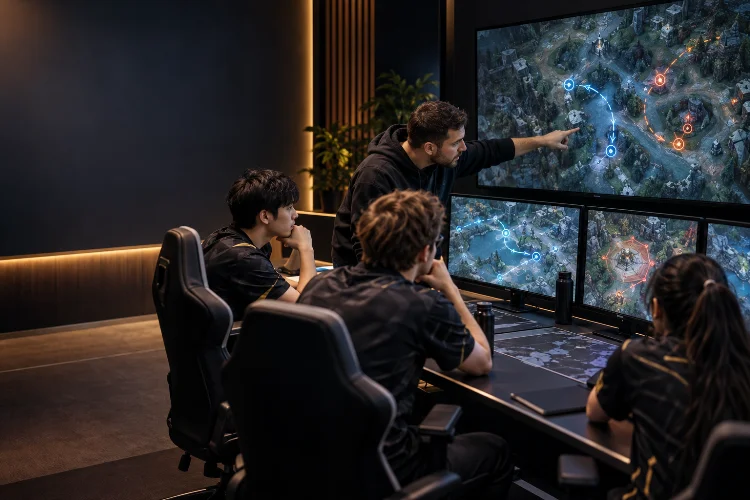
Ever watched a professional esports tournament and wondered how top players consistently make the right decisions under incredible pressure?
One moment, they’re calmly controlling the map. A few seconds later, they’re executing a perfectly coordinated attack that leaves their opponents completely overwhelmed.
It might look like incredible reflexes or natural gaming talent. But there’s actually a lot more happening behind the scenes.
At the highest levels of competitive gaming, mechanical skills are only part of the equation.
Professional players also rely on strategic planning, precise communication, resource management, psychological discipline, and the ability to predict what their opponents might do next.
That’s where advanced competitive gaming strategies become essential.
Whether you’re competing in Valorant, Counter-Strike 2, League of Legends, Dota 2, or another competitive title, understanding these principles can dramatically change how you approach matches.
And here’s the interesting part: becoming a better player doesn’t always mean spending more hours grinding ranked games.
Sometimes, the biggest improvements come from learning how to think differently.
Let’s explore the strategies that can help serious players develop a more intelligent, consistent, and competitive approach to esports.
1. Develop Strategic Thinking Beyond Mechanical Skills
Mechanical ability is obviously important in competitive gaming.
You need accurate aim, fast reactions, efficient movement, and strong control over your character or champion. However, mechanical excellence alone rarely guarantees victory against well-organized opponents.
High-level competition requires players to understand the bigger picture.
Focus on Win Conditions Instead of Individual Highlights
One of the biggest differences between average players and experienced competitors is how they define success.
An inexperienced player might focus primarily on eliminations, damage numbers, or personal statistics. A strategic player asks a more important question: What actually needs to happen for our team to win?
In a tactical shooter, winning might require controlling a particular bombsite, protecting an important position, or forcing opponents to waste valuable utility.
In a MOBA, the priority could be securing map objectives, protecting a scaling carry, or creating pressure across multiple lanes.
These are known as win conditions.
Before committing to an aggressive play, consider whether it directly supports your team’s objectives.
A flashy elimination means very little if your team loses the round immediately afterward.
Improve Your Decision-Making Process
Elite competitors continuously evaluate risk and reward.
Imagine you’re defending a crucial position in Valorant. You spot an enemy moving into your area, but you’re completely alone.
Should you challenge them immediately?
Not necessarily.
Depending on the situation, retreating, communicating the enemy’s location, and waiting for reinforcements might create a much stronger defensive opportunity.
This is where strategic discipline becomes valuable.
Developing better gaming decisions involves evaluating available information, understanding potential consequences, and choosing actions that maximize your team’s chances of success.
Over time, these habits become increasingly automatic.
2. Master Map Control, Information Gathering, and Game Tempo
Information is one of the most valuable resources in competitive esports.
Knowing where opponents are positioned, which areas they control, and what resources they have available allows teams to make more accurate decisions.
Without reliable information, even highly skilled players are forced to guess.
Understand the Real Meaning of Map Control
Map control isn’t simply about occupying territory.
It’s about controlling important areas while limiting your opponents’ movement, vision, and available options.
In Counter-Strike 2, controlling central map positions can create opportunities for rotations, coordinated attacks, and defensive adjustments.
In League of Legends, vision around important objectives helps teams identify enemy movement and prepare for potential fights.
Riot Games emphasized this relationship between vision and strategic decision-making in its League of Legends Patch 26.1 Notes, which introduced new vision mechanics designed to reward tactical choices.
The underlying principle applies across multiple esports genres: better information creates better opportunities.
Control the Pace of Engagements
Professional teams rarely maintain the same tempo throughout an entire match.
Sometimes, they play aggressively to pressure opponents and establish momentum. Other times, they deliberately slow down to gather information, recover resources, or prepare coordinated attacks.
Imagine an opposing team consistently pushes aggressively during the opening seconds of each round.
Instead of repeatedly challenging that aggression, your team could play defensively, encourage opponents to overextend, and punish their predictable movement.
This is called tempo manipulation.
The goal is to influence when and where engagements happen rather than allowing opponents to dictate every encounter.
Players who understand pacing can turn seemingly unfavorable situations into valuable tactical opportunities.
3. Optimize Resource Management and Competitive Efficiency
Winning in esports isn’t always about having superior mechanical abilities.
Quite often, the difference comes down to how effectively teams manage limited resources.
Depending on the game, these resources might include money, ammunition, abilities, cooldowns, information, positioning, or available time.
Build Strong Economic Awareness
Economy management is particularly important in tactical shooters.
For example, Valorant requires players to make purchasing decisions before rounds begin. As explained in Riot Games’ Valorant Beginner’s Guide, weapon purchases and abilities depend on available credits and team strategy.
A player might have enough money to purchase an expensive weapon, but that doesn’t automatically make it the best decision.
Sometimes, saving resources allows the entire team to coordinate a stronger purchase during the following round.
Buying seperately without considering teammates can create an inconsistent team economy.
Instead, communicate purchasing intentions and develop a shared plan.
A coordinated team with balanced equipment often has more strategic flexibility than five individuals making completely independent decisions.
Track Abilities and Important Cooldowns
Resource awareness also applies to ability-based competitive games.
Consider a League of Legends team preparing for a major objective fight.
If an opposing champion has recently used an important ultimate ability, your team may have a temporary opportunity to engage with reduced risk.
Similarly, in Valorant, tracking defensive utility can help attackers identify the right moment to execute a coordinated site entry.
Advanced players don’t simply react to abilities when they appear.
They actively remember which resources have already been used and adjust their strategies accordingly.
This creates more predictable engagements and improves overall tactical efficiency.
4. Build Professional-Level Team Communication and Coordination
You can have five mechanically gifted players on the same roster and still end up with a surprisingly weak team.
Why?
Because individual talent doesn’t automatically produce teamwork.
Effective esports communication requires clarity, timing, trust, and an understanding of each player’s responsibilities.
Make Communication Clear and Actionable
During intense competitive matches, unnecessary conversation can become a serious distraction.
Professional-level communication should prioritize useful information.
Instead of shouting that an opponent is nearby, a player could identify their location, movement direction, and potential threat.
For example, saying “Two enemies moving toward B, one utility ability used, possible rotation” gives teammates information they can act on immediately.
A 2025 study published in the Journal of Sport and Exercise Psychology analyzed 4,040 statements across eight Counter-Strike matches.
Researchers found that expert teams communicated more effectively, emphasizing factual and action-related statements while distributing communication more evenly among players.
The lesson is straightforward: useful communication matters more than simply talking constantly.
Establish Clear Team Roles
High-performing teams also benefit from defined responsibilities.
An in-game leader might coordinate strategic decisions, while other players specialize in gathering information, initiating engagements, controlling important areas, or supporting teammates.
These responsibilities reduce confusion during high-pressure moments.
However, having established roles doesn’t mean players should become inflexible.
A strong competitor understands their primary responsibilities while remaining capable of adjusting when the match demands something different.
Research published in Team Performance Management examined coordination among 80 professional gamers across 16 esports teams.
The researchers identified measurable relationships between coordination patterns and offensive or defensive performance outcomes.
That reinforces an important competitive principle: coordinated actions can create advantages that individual mechanics cannot achieve alone.
Develop Trust Through Consistent Practice
Trust is built through repeated experience.
When teammates understand each other’s tendencies, they can coordinate without explaining every decision.
This becomes especially valuable during clutch situations, complex team fights, and fast rotations.
Regular team reviews, constructive feedback, and clear strategic expectations can help build this chemistry.
And remember, criticizing teammates after every mistake rarely produces better coordination.
Focus on solving problems rather than assigning blame.
5. Use Opponent Analysis and Tactical Adaptation
At higher competitive levels, predictability becomes a serious weakness.
Opponents study tendencies, recognize familiar strategies, and look for opportunities to exploit repeated mistakes.
That’s why successful teams constantly adapt.
Identify Patterns in Opponent Behavior
Start by observing how opponents approach common situations.
Do they frequently attack the same objective? Does one player consistently take aggressive positions? Are defensive rotations unusually fast?
These patterns can provide valuable clues about their strategic preferences.
For example, a team that repeatedly commits multiple players to early aggression might leave another area temporarily vulnerable.
Recognizing that weakness creates opportunities for counterplay.
However, avoid assuming that one observed action represents a permanent pattern.
Try to identify repeated behavior across several rounds before making major tactical adjustments.
Create Flexible Strategies
A strong game plan should include alternatives.
Imagine your team prepares an aggressive early-game strategy, but your opponents successfully counter it during the opening stages.
Continuing to repeat the same approach may only make the situation worse.
Instead, your team could slow down, change positioning, adjust its resource allocation, or pressure a different objective.
The ability to switch strategies without losing coordination is a major advantage.
Understand the Competitive Meta
The competitive meta refers to strategies, characters, equipment, and playstyles that are considered effective under the current game conditions.
However, copying a popular strategy without understanding it can create problems.
A professional composition might require precise coordination that your team hasn’t developed yet.
Instead of blindly following trends, study why certain strategies work and determine whether they fit your roster’s strengths.
You should definately monitor balance updates, tournament trends, and strategic innovations, but experimentation remains essential.
The most effective strategy is one your team can execute reliably against the opponents you’re facing.
6. Create an Advanced Esports Training and Performance Analysis System
Playing more games can provide valuable experience.
But playing without clear objectives often reinforces existing mistakes.
Serious improvement requires a structured approach to training.
Practice Specific Skills With Purpose
Rather than spending an entire evening playing ranked matches, divide your training into focused activities.
For tactical shooters, this might involve crosshair placement, positioning, recoil control, movement, and decision-making under pressure.
MOBA players might prioritize wave management, map awareness, objective timing, champion mechanics, or team-fight positioning.
The goal is to isolate specific weaknesses and improve them through repeated, meaningful practice.
A research paper on esports coaching and talent development discusses why simply increasing practice hours is not necessarily the most effective route toward higher performance.
Purposeful training, appropriate feedback, and better coaching structures can help players develop more efficiently.
Turn Gameplay Replays Into Learning Opportunities
One of the most effective ways to recognize mistakes is to review your own gameplay.
During live matches, your attention is divided between numerous simultaneous events.
Replays allow you to examine decisions more carefully.
Valorant’s official replay documentation describes features such as multiple player perspectives, timeline navigation, playback controls, and free-camera observation.
These tools can help competitors understand mistakes that were difficult to recognize during actual gameplay.
When analyzing a replay, focus on three questions:
What information was available before the mistake?
What alternative decisions were possible?
What should you do differently in a similar situation?
For example, maybe you lost a crucial engagement because you entered an area without confirming your teammate’s position.
Instead of blaming slow reactions, you might discover that poor coordination created the disadvantage.
That insight is much more useful than simply practicing aim for another hour.
Track Meaningful Performance Indicators
Statistics can help reveal improvement, but they need proper interpretation.
Kill-death ratios, accuracy percentages, damage numbers, and win rates provide useful information.
However, they don’t always explain why a player succeeds or struggles.
Consider tracking indicators directly connected to your training objectives.
A tactical shooter player might measure how often they die without receiving a teammate trade.
A MOBA player might monitor unnecessary deaths before major objectives or how consistently they manage waves.
Review these results regularly to identify patterns.
For example, a weekly training routine could include dedicated mechanical practice, several focused competitive sessions, replay reviews, and one structured team discussion.
Use your performance data to determine which activities deserve additional attention.
This approach makes improvement easier to evaluate and helps prevent aimless grinding.
7. Strengthen Mental Resilience and Tournament Performance
Even highly skilled players can struggle when competitive pressure increases.
Tournament matches often involve intense expectations, unfamiliar opponents, long schedules, and emotionally demanding situations.
Managing those challenges is part of becoming a complete esports competitor.
Develop Emotional Control During Matches
Imagine losing a crucial round because of a small mistake.
It’s tempting to become frustrated, criticize yourself, or immediately attempt an unnecessarily aggressive play.
Unfortunately, emotional reactions can create additional mistakes.
A better approach is to recognize what happened, communicate necessary information, and focus on the next decision.
Mental resilience doesn’t mean eliminating emotions.
It means preventing emotions from controlling your gameplay.
Develop a simple reset routine between rounds, such as relaxing your shoulders, taking a controlled breath, and identifying the next tactical priority.
Build Sustainable Training Habits
Long gaming sessions may feel productive, but excessive practice can become counterproductive when recovery is neglected.
Sleep, physical activity, nutrition, and regular breaks deserve attention alongside technical training.
A 2025 study in Scientific Reports investigated sleep counseling among competitive Valorant players.
Researchers observed improvements in reaction-time tests and a small improvement in heart rate variability, but they did not find significant improvements in gaming performance. Participants also did not significantly extend their sleep duration.
These findings highlight how complicated the relationship between recovery and esports performance can be.
Getting more sleep isn’t a guaranteed shortcut to winning, but maintaining healthy routines remains important for overall well-being and sustainable training.
Prepare for Competitive Pressure
Tournament preparation should involve more than learning strategies.
Practice communication under stressful conditions, simulate important match situations, and develop pre-match routines that help maintain concentration.
Teams can also conduct structured practice matches with specific objectives.
For instance, one session might emphasize recovering from an early disadvantage, while another focuses on maintaining composure after losing several consecutive rounds.
These exercises help competitors become more comfortable with uncertainty.
The objective isn’t to eliminate every mistake.
It’s to remain consistant enough to make good decisions even when the match becomes chaotic.
Learn to Recover From Defeats
Losses are unavoidable in competitive gaming.
Even experienced teams encounter unexpected strategies, individual mistakes, and unfavorable situations.
What matters is how you respond.
Instead of treating every defeat as proof that you’re not good enough, use it as feedback about your current approach.
Identify one or two actionable improvements rather than attempting to fix everything immediately.
Sometimes, a difficult loss reveals the exact weakness your team needs to address before its next major breakthrough.
Mastering advanced competitive gaming strategies requires much more than fast reflexes or impressive individual statistics.
The strongest esports competitors combine mechanical skills with intelligent decision-making, effective communication, map awareness, resource discipline, and tactical flexibility.
They also understand the value of structured practice, gameplay analysis, and maintaining focus when competitive pressure increases.
Most importantly, they treat improvement as an ongoing process rather than expecting instant results.
You don’t need to transform every aspect of your gameplay overnight.
Start by identifying one weakness, create a focused training plan, and measure your progress over time.
Whether you’re climbing ranked ladders, competing in amateur tournaments, or pursuing a professional esports career, smarter preparation can make a meaningful difference.
Ready to level up your competitive performance? Start applying these strategies in your next training session and turn every match into an opportunity to improve.